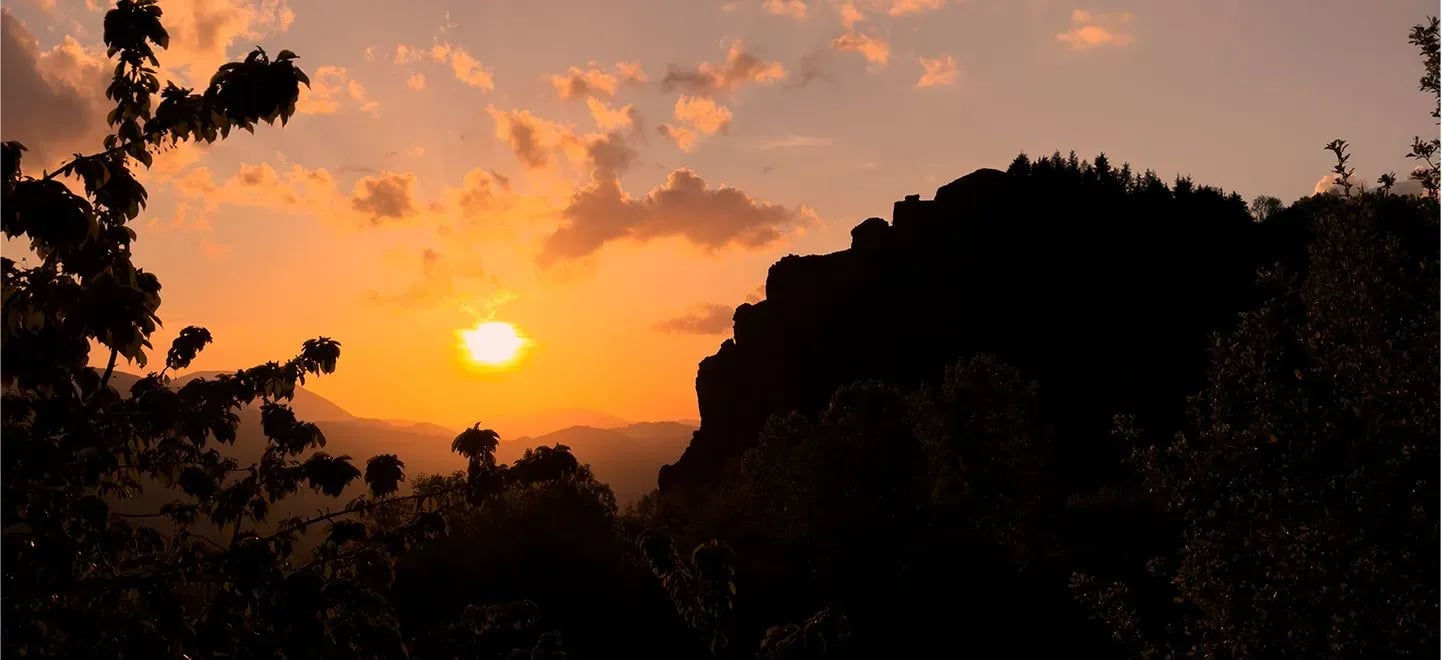
At the highest point of Duronia, a village of a few hundred people in the Molise mountains, a cliff face stares back. Locals call it the Giant: a massive outcrop of rock that has weathered, over centuries, into the unmistakable profile of a human face, eyes and brow and jaw all legible from below. It is the only natural monument of its kind recognised in the entire Molise region, and it sits directly above San Tommaso, the highest quarter of the village, where on a clear day the view opens onto dozens of neighbouring towns.
The Giant did not appear by accident of geography alone. It stands on the Civita, once a Samnite stronghold, positioned to watch over the tratturi, the ancient grass drove-roads along which shepherds moved their flocks between mountain and lowland pasture for thousands of years. Whoever built there chose the spot for the same reason walkers choose it now: from the Civita, nothing approaches unseen. The rock face, then, has been doing its job for longer than anyone in Duronia can trace. It watched the Samnites guard the transhumance routes. It has watched, more recently, something harder to defend against: the slow emptying of the village itself.
Duronia is one of the hundreds of small settlements in Italy's aree interne, its inland hinterlands, that have spent the last decades losing people the way a body loses heat, steadily and almost imperceptibly, until the pattern becomes impossible to ignore. Miriam Iacovantuono, writing for Artribune, remembers a Duronia with more voices in it: women knitting and talking in doorways, children chasing a ball through the vicoli. Some of that has thinned out. But the Giant has not moved, and neither, entirely, has the village's pulse. The old tratturo below it, once a green motorway for sheep and shepherds, now draws walkers who come for the wildflowers and the silence. Young people who left to travel abroad have, in a few cases, come back to open businesses of their own. The piazza still fills in spring, when the long winter breaks and the village, in Iacovantuono's phrase, unfolds like a flower.
What makes Duronia worth knowing about is not that it has been saved. It has not, not in any final sense. It is that a place this small has, sitting above it, a genuinely unique geological witness: a face carved by nothing but wind and time, that has outlasted the Samnites, the shepherds, and now watches a different kind of vigil, over a community deciding, generation by generation, whether to stay.


