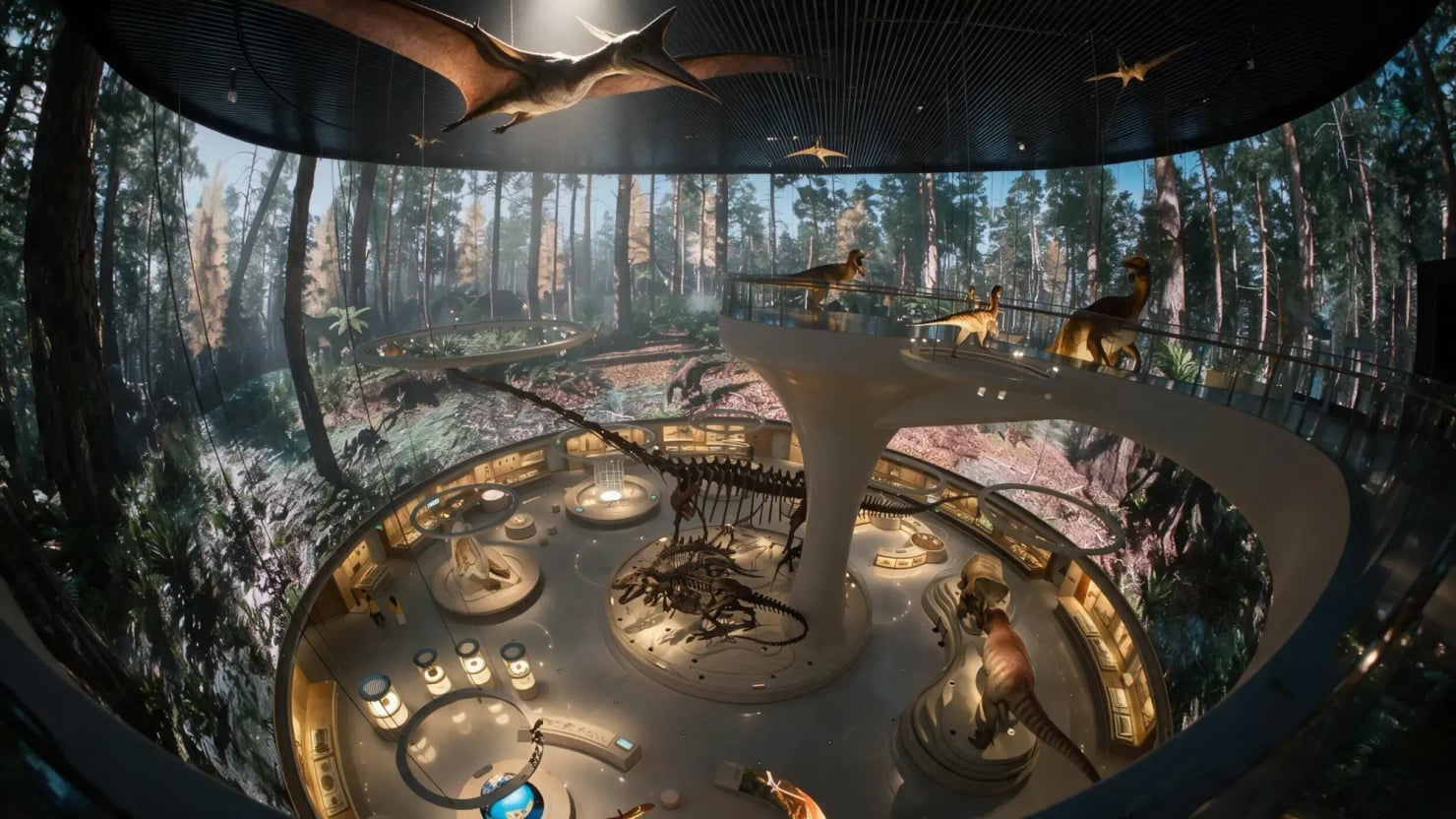
Twenty-one metres. That is the height of the new dinosaur hall at the Shenzhen Natural History Museum, roughly the equivalent of a seven-storey building, and it is the single tallest exhibition space in a museum that just opened as one of the largest of its kind on Earth.
The museum, spread across 105,000 square metres in southern China, has been designed by Atelier Brückner, the Stuttgart studio that made headlines for its work on the Tutankhamun galleries at the Grand Egyptian Museum in Cairo. In Shenzhen, the firm has applied the same instinct for theatre to a very different subject: the four-billion-year story of life on the planet.
The dinosaur hall is the climax of the visit. Rather than lining up skeletons in a row, the design sends visitors through layered, immersive prehistoric landscapes, using light, sound and staging to move them through the lives, adaptations, extinctions and survival strategies of creatures that vanished tens of millions of years ago. It sits within a wider sequence: a Cosmos Hall tracing astronomy from early human observation to modern cosmology, an Earth Hall built around the forces that shaped the planet's crust, and an Evolution Hall devoted to the sheer diversity of life.
The museum brands itself a 'smart museum', built on interactive stations and media installations designed to make science feel less like information and more like experience. That is the real bet here: that scale alone does not move people, but scale paired with atmosphere might.
Whether the dinosaurs of Shenzhen will draw the crowds that Tutankhamun's mask drew in Cairo remains to be seen. But the ambition is explicit, told through the same design language, in a building that treats extinction itself as a story worth walking through, three storeys at a time.


