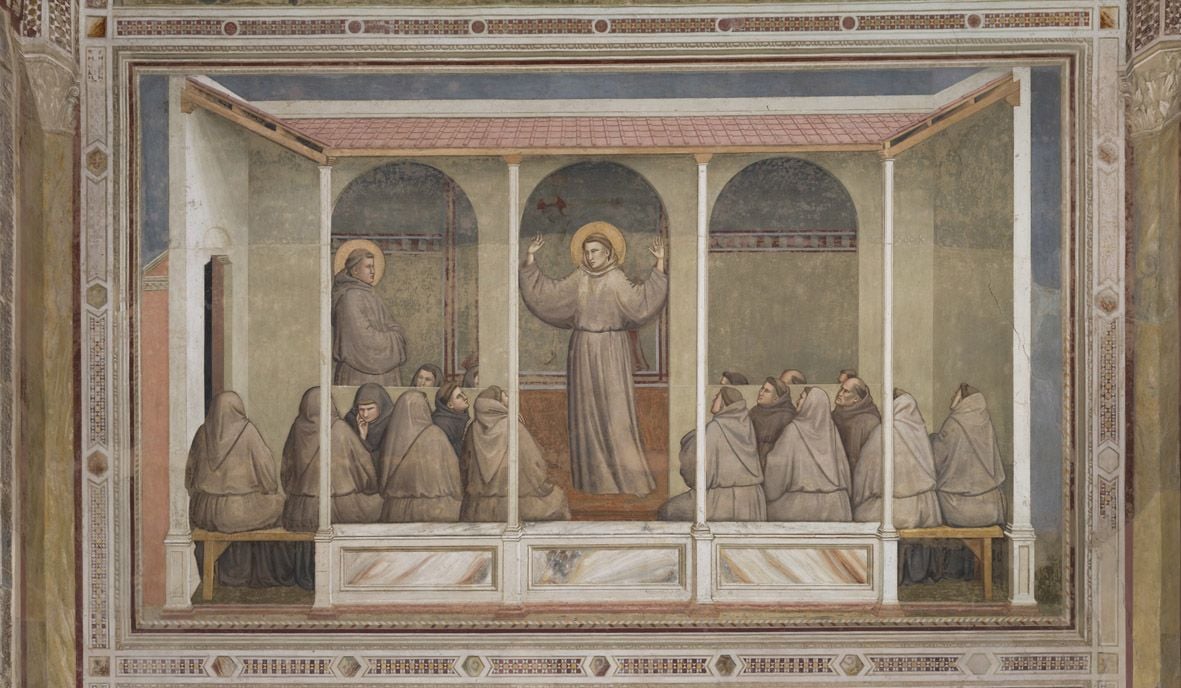
In the Bardi Chapel of the Basilica of Santa Croce, around 180 square metres of paintings tell the story of the life of Saint Francis. Six large scenes unfold along the side walls; above the entrance arch is the Stigmata, while the end wall and the vault contain saints and allegories of the Franciscan virtues.
After four years of investigation and conservation work, the cycle painted by Giotto and his workshop is visible once again. The restoration, promoted by the Opera di Santa Croce and designed and carried out by the Opificio delle Pietre Dure, addressed two needs at once: protecting what remains of the paintings and making them easier to understand.
The works belong to the mature phase of Giotto’s career. Their precise dating is still debated, but they were certainly made after 1317, the year Saint Louis of Toulouse was canonised. He is depicted on the end wall. The commission is most probably attributed to Ridolfo de’ Bardi, a member of one of Florence’s most powerful banking families.
The six scenes represent key moments in the Franciscan story: the renunciation of his father’s possessions, the approval of the Rule, the appearance before the Chapter at Arles, the trial by fire before the sultan, the saint’s death and the subsequent apparitions. Giotto organises the episodes through the buildings, gazes and gestures of the figures. Architecture is not simply a setting: it establishes the relationships between the figures and guides the gaze of the viewer.
Painted columns, frames and vault sections connect the different scenes and are ideally superimposed on the chapel’s real architecture, transforming it into a unified space. To construct this framework, Giotto and the painters in his workshop incised lines into the plaster and used cords impregnated with colour, stretched and struck against the surface.
For the first time, the restoration has made it possible to map these marks digitally. By following the incisions and snapped lines, it is now possible to reconstruct more precisely the process by which the painted space was designed before the colours were applied.
The investigations have also clarified the technical and stylistic differences between the various parts of the cycle. Giotto did not work alone: he coordinated a workshop made up of several painters, to whom he entrusted sections of the work. The chapel therefore documents both the master’s vision and a collective organisation of labour, in which different skills and ways of painting contributed to the construction of a shared visual language.
Most of the images were executed in fresco, with colours applied to still-wet plaster. Many details, however, were added a secco, when the wall was already dry. This technique made it possible to use a wider range of pigments, vary the colour effects and manage the timing of the work more freely. The parts painted a secco, being more fragile, have suffered particularly extensive losses over time.
The present condition of the paintings also depends on interventions carried out in later centuries.
Before 1730, the cycle was hidden beneath several layers of limewash. At the beginning of the nineteenth century, two cenotaphs were installed in the lower part of the side walls. When the frescoes were rediscovered in 1851, Gaetano Bianchi mechanically removed the whitewash. The operation brought the images back to light, but it also caused abrasions, scratches and losses of colour. The removal of the cenotaphs also led to the definitive loss of the painted sections that had been behind the monuments.
According to the standards of his time, Bianchi reconstructed the missing parts and unified the surfaces with a tempera patina. For around a century, the public therefore saw an image in which fourteenth-century painting and nineteenth-century additions were difficult to distinguish.
Between 1957 and 1959, Ugo Procacci and Leonetto Tintori followed a different approach. They removed Bianchi’s overpaint in order to recover what remained of the original material, and kept the nineteenth-century additions separate because of their documentary value. Tintori toned down the small losses of colour, but left the gaps in the plaster neutral: around five thousand interruptions that restored authenticity to the work, while making it more difficult to read.
The restoration begun in 2022 has worked with this complex legacy. Cracks, sections of plaster at risk of detaching and areas where the paint layer was lifting have been consolidated. Deterioration caused by salts has been reduced, deposits and altered materials have been removed, and many old synthetic fills have been replaced with mixtures more compatible with the original plasters.
Not all losses have been treated in the same way. The large gaps caused by the cenotaphs have remained recognisable, because they testify to an irreversible and precisely documented transformation. Some essential lines of the painted architecture have been reconstructed in a lighter tone, distinguishable from the original. Small losses and abrasions, by contrast, have been softened where the surviving traces made it possible to restore continuity to the image without inventing what no longer exists.
Particularly significant results have emerged in the vault, which had been less affected by previous restorations. Cleaning, carried out in some areas with laser tools, has brought back details of the allegories of Obedience and Chastity that had become illegible or had been interpreted incorrectly.
The cycle now appears more comprehensible, but it has not been returned to a supposed original state. Such a condition could not be recovered: the lost parts remain lost, and every intervention carried out in the chapel now belongs to its history.
The restoration has chosen not to erase this distance. It allows the construction of Giotto’s space and the work of his workshop to be followed more clearly, while also leaving visible the consequences of the painting’s concealment, rediscovery and the different ideas about restoration that have followed one another.
What returns before our eyes is not only the image painted in the fourteenth century. It is a work that carries on its surface the decisions made by many people at different times: those who created it, those who covered it, those who tried to reconstruct it and those who have now chosen how far to intervene.


