As a child in Ulassai, in the mountains of Sardinia's Ogliastra region, Maria Lai watched the sewing machine live in the brightest, most beautiful room in the house. It was where the women of the family went to escape everything else: chores, walls, the rest of a life confined indoors. That single detail, tucked into the curatorial notes for a new exhibition in Naples, explains more about Lai's art than any manifesto could.
Born in 1919, Lai spent her career trying to do something that sounds impossible: make the sky touchable. 'I search for skies, spaces that are very distant, yet tactile,' she once said, a phrase recalled by curator Gregorio Botta for Tessere la notte (Weaving the Night), the exhibition Studio Trisorio in Naples has dedicated to her, running until 24 October 2026. The show gathers works made between 1978 and 2011: looms, sewn books, geographic pieces, sheets, ceramics, shawls. All of it built from the most unremarkable materials imaginable, thread, wool, cotton, cloth, bread dough, and all of it aimed at the most unreachable subjects: memory, distance, the night sky itself.
Lai abandoned flat painting early. She wanted art with a body, something you could know with your fingers rather than just your eyes, and she found it in the tools of domestic women's work: the loom, the needle, the pillowcase. What in her mother's house had been a private, almost secret pleasure, one of the few spaces where women could express themselves freely, Lai pulled out into the open and turned into sculpture. It reads as an act of reclamation as much as an aesthetic choice.
The exhibition's title piece, Tessere la notte, is a deconstructed loom threaded through with two of Lai's recurring obsessions: a goat, and the components of a sundial. She called such pieces 'object landscapes', things that stop being useful and start meaning something instead. Thread, for Lai, picked up exactly where language gave out: it could stitch, connect, imply, without ever having to spell anything out.
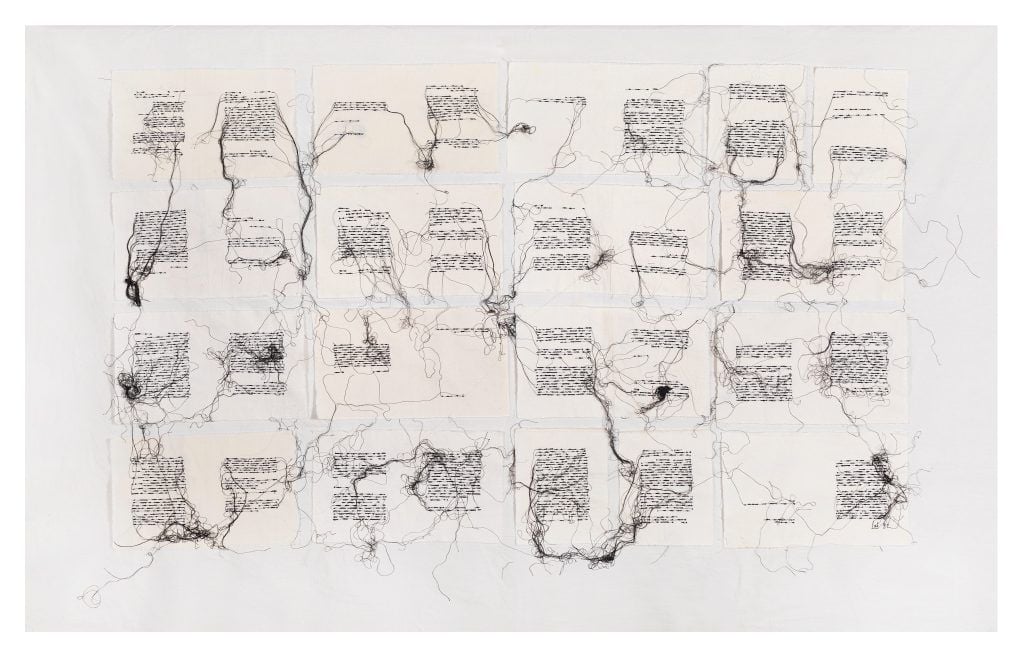
One sewn book from 1979 makes the point with unnerving clarity. Its pages are photocopies, mechanically identical, yet on each one Lai intervened by hand with a gesture that could never be repeated. She was staging, decades before anyone used the term, a deliberate collision between technical reproduction and the singularity of the human hand, a tension that now reads as almost prophetic.
The goat recurs throughout her work as something close to a self-portrait: an animal unafraid of scaling the highest peak or plunging straight off it. Lai drew its outline, then handed the shape to artisan weavers in her Sardinian village and let each one fill it with her own private patterns. The piece came back to her multiplied, at once unrecognisable and utterly hers.
A second Trisorio space in via Carlo Poerio holds Tenendo per mano l'ombra (Holding the Shadow by the Hand, 1987), a fairy tale told in sewn pages and dyed, embroidered cloth. It is the clearest evidence of what the whole show argues: that Lai's real material was never thread at all. It was the domestic gesture itself, lifted out of the house and turned into something the rest of us could finally read.


