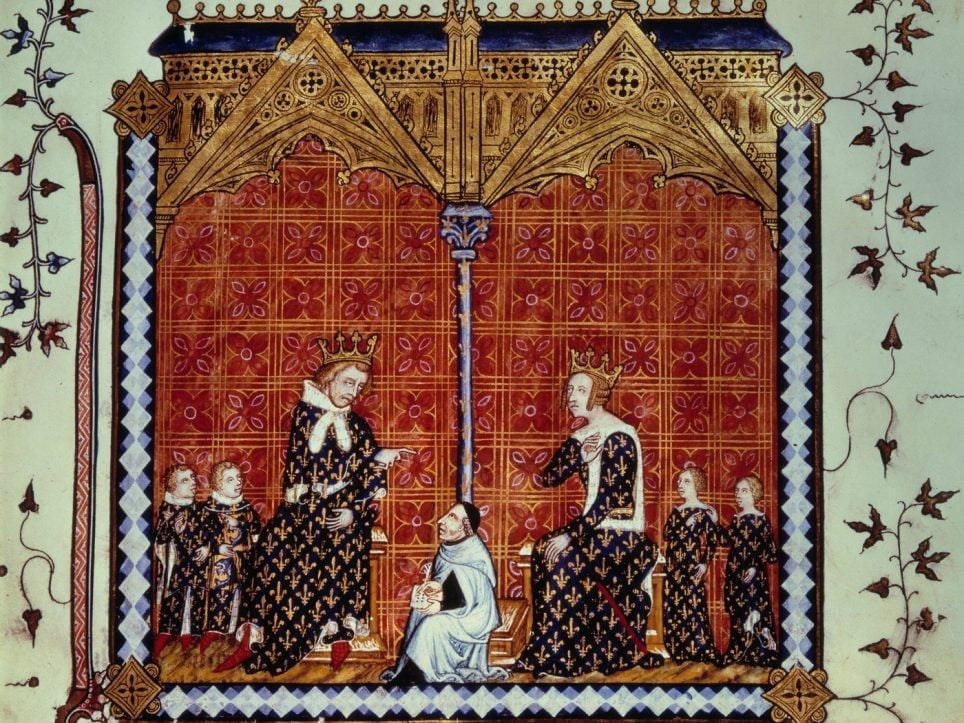
Look at a medieval king painted beside his own castle, and he is enormous, head brushing the clouds, the towers below him no bigger than his knee. Look at a Virgin Mary rising taller than the cathedral she stands in, or courtiers shrunk to the size of dolls at their lord's feet. The instinct is to laugh: these artists could not draw.
They could. They simply were not drawing what the eye sees. They were drawing what mattered.
Art historians call it hierarchical perspective, and once you know the rule, medieval art stops looking clumsy and starts looking coded. Size, in this system, is not about distance from the viewer. It is about importance. That is why Christ in Majesty fills the entire centre of a Romanesque tympanum, why the apostles, smaller, line up obediently beneath him, and why the damned, tiniest of all, are crammed into the margins like an afterthought. The proportions are not an error in the drawing. They are the argument of the drawing.
The examples pile up fast. In the Codex Manesse, that lavish German songbook from around 1305, lords loom over their vassals, who are reduced to figurines. In Byzantine illuminated Gospels, Christ Pantocrator sits frozen against a gold background, so large he seems to swallow the whole composition. In each case, the artist is not failing to render three-dimensional space. He is rendering a chain of command.
There is a subtler idea buried in this, one worth sitting with: in medieval painting, the world is not organised around the eye of the person looking at it. It is organised around the gaze of whoever is sacred within the scene. A kneeling worshipper in front of a Christ in Majesty is not viewing a realistic tableau from his own vantage point. He is being shown God's-eye view of the order of the universe, and in that order, he is small on purpose.
This also explains one of medieval art's strangest quirks: its vanishing lines diverge instead of converging, the opposite of the linear perspective the architect Brunelleschi would invent in Florence in the 15th century. The mathematician and art historian Denis Favennec has traced this in 14th-century frescoes and panels, where the recession of space across different planes follows no consistent law at all. Several perspectives happily coexist in a single image, and neither the painter nor his medieval audience found that remotely disturbing. It took Giotto, at the start of the 14th century, to attempt the first believable depth on a flat surface, and Paolo Uccello and the Renaissance painters after him to lock painting into a single vanishing point.
But the convention did not begin in medieval Europe, and it did not end there either. Writing in the journal Anastasis: Research in Medieval Culture and Art in 2015, the Romanian art historian Daniel Sofron traced hierarchical perspective through Byzantine art and through Western European Romanesque and pre-Romanesque work, all the way back to ancient Egypt, where wall paintings show a towering pharaoh with his sandal pressed on the bowed backs of kneeling slaves rendered a fraction of his size.
Medieval artists, in other words, invented nothing. They inherited a visual language already thousands of years old, one built on a single, quietly radical premise: that a picture is allowed to lie about measurements, if the lie tells a bigger truth.


