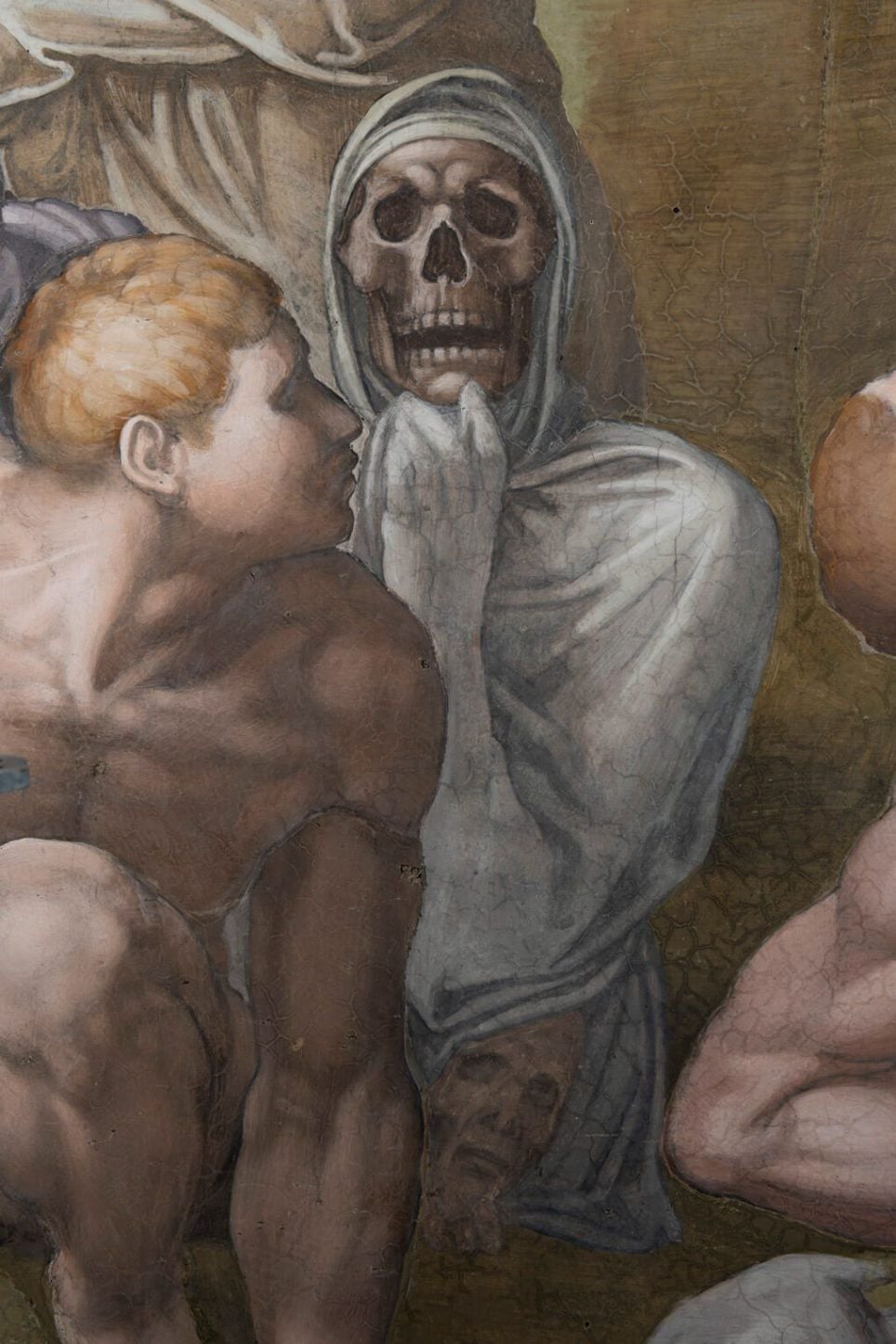
In Michelangelo’s Last Judgement, several groups of parallel brushstrokes follow the same undulating pattern. According to Finestre sull’Arte, Paolo Violini, head conservator of the Vatican Museums’ Paintings and Wood Materials Restoration Laboratory, noticed this feature while examining the fresco at close quarters during conservation work in 2026. www.finestresullarte.info
The work, carried out between 1 February and 27 March, removed a whitish film that had muted the colours and softened the contrasts between light and shade. Scaffolding allowed conservators to examine the entire surface of the Sistine Chapel’s altar wall. www.museivaticani.va
The repeated undulations led Violini to propose that Michelangelo used multi-tipped brushes, producing several strokes in a single movement. As reported by Finestre sull’Arte, Violini identifies traces across the Sistine Chapel frescoes suggesting tools with three tips and others up to 15 centimetres wide, which may have combined as many as ten small brushes. Their proposed configuration is inferred from the painted marks. www.finestresullarte.info
According to Violini, these tools would have enabled Michelangelo to achieve a painted effect resembling the marks of a gradina, the toothed chisel used to carve marble. By overlaying groups of lines running in different directions, the artist created a crosshatched texture on the plaster, comparable to the marks left by the chisel on stone.