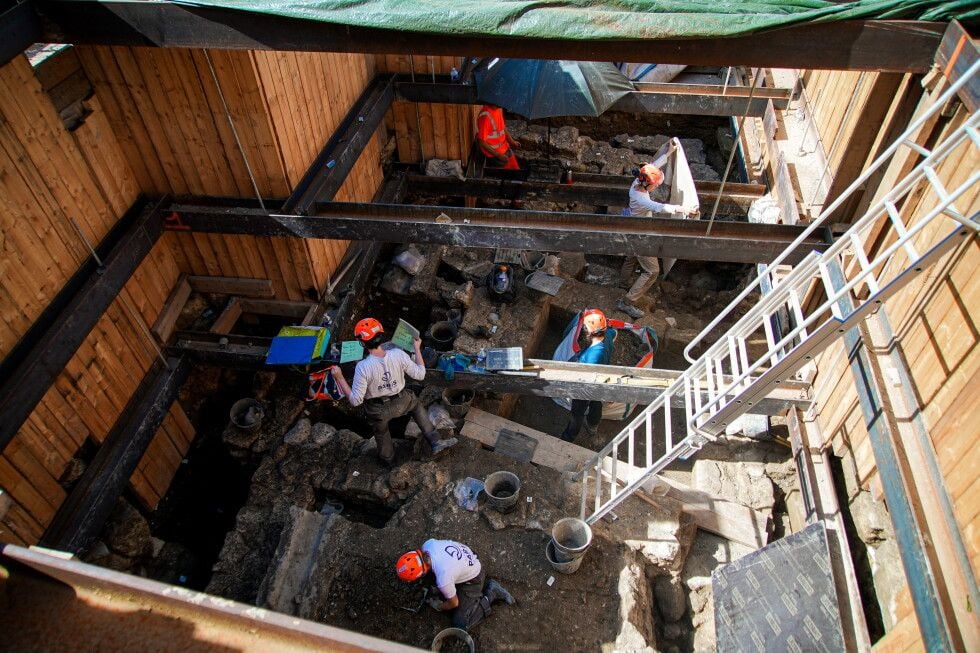
Four metres beneath the queue of tourists waiting to climb Notre Dame's towers, an archaeologist is standing in the fourth century.
Paris wants to plant 160 trees in the cathedral's bare, sun-baked forecourt, part of a plan to cool a city bracing for hotter summers. But in a city this old, no one is allowed to turn the soil until someone has checked what is buried in it. So a strip of the forecourt has become a pit, ringed by barriers, crossed by a wooden walkway, a few steps from the ticket line. French media have called it the dig of the century. It might undersell it.
The first traces show up just 50 centimetres down. Four metres lower, the team led by archaeologist Camille Colonna is still pulling up the past, some days filling fifteen crates from ground that has not been touched in decades, according to the Associated Press, which visited the site.
What they are moving through is not soil so much as sediment of centuries. Notre Dame rose in 1163 on a square then packed with medieval houses split by a single street. Below those foundations lie Merovingian and Carolingian grain pits from the sixth to tenth centuries. Below those, darker and older, a dense Roman quarter from the fourth and fifth centuries, when the city was called Lutetia and its centre stood across the river. As Rome collapsed, people retreated to this island and fortified it with stone stripped from older buildings; the team found a Roman doorstep, torn from some grander structure, flipped over and reused as paving in a road. Twenty centuries compressed into four metres of earth, roughly the height of two and a half Napoleons stacked on top of one another.
The richest finds have come from the foulest place: medieval latrines that doubled as rubbish pits. The soft waste cushioned what fell in, so whole jugs and cups have come up intact after seven hundred years, alongside broken plates and animal bone. Complete ceramics are rare in this line of work, said Valentine Breloux, an archaeologist with the Paris unit; here they keep surfacing whole.
Then there is the pottery nobody can explain. Conservators cleaning what looked like ordinary medieval shards found faint reddish writing painted on the inside, the same unreadable marks appearing again and again. No expert has worked out what they say. Breloux calls them the most astonishing thing she has cleaned from the whole site, a small mystery sitting quietly in a storeroom while everyone tries to decide what it means.
A blackened, rust-eaten coin turned out, under X-ray, to carry the face of the emperor Constantine, precise enough to help date the layer it came from. Every object leaves the pit for the city's archaeology centre, what Colonna calls a huge archaeological store, already swelling with finds.
The dig only exists because Paris decided to beautify a square. The new one, with its trees and a thin film of cooling water over the stone, should be largely finished by 2028; the old underground car park will reopen as a visitor centre facing the Seine. Until then, the team wants to push past the Romans entirely, down toward the Gauls who gave the city its first name. The hope, said conservator Lucie Altenburg, is to go back further than anyone here has ever gone.


