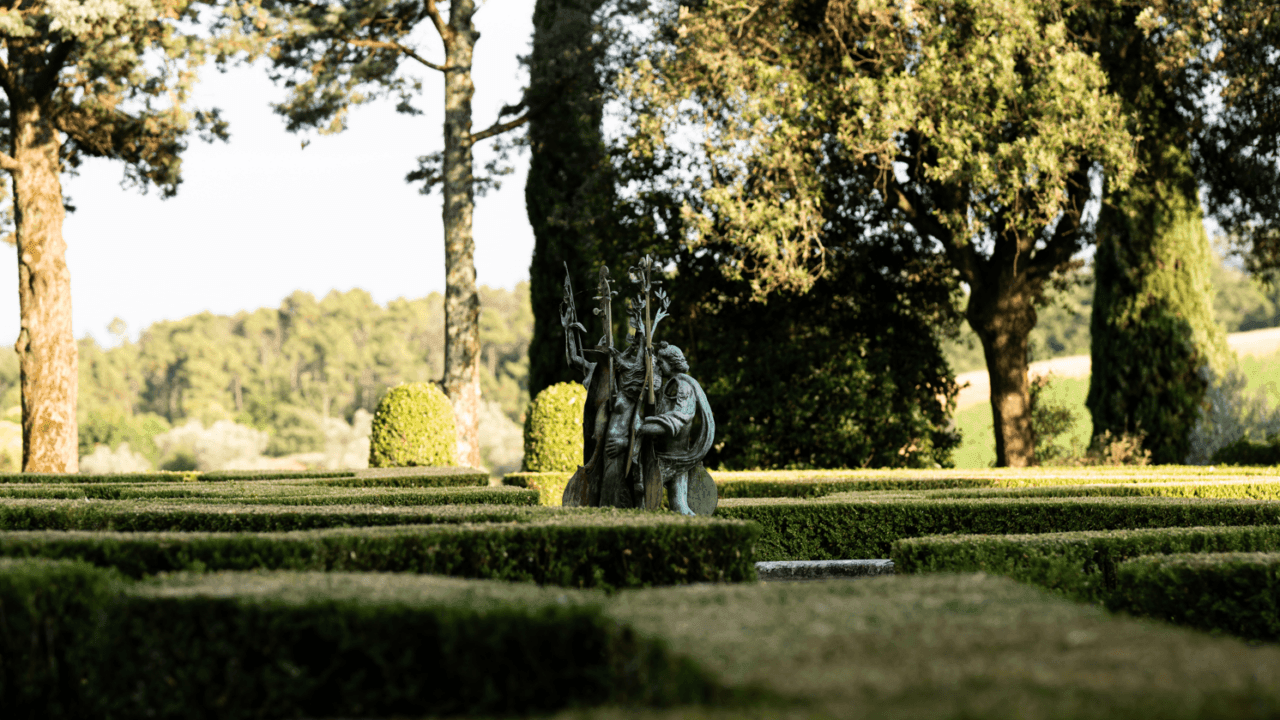
On the evening of 13 September, a procession of lanterns inspired by the Rificolona tradition accompanied the audience to the Italian-style garden of Villa del Cigliano. Beside a pool reflecting the night sky stood Astronomo (via dalla mia luce), a sculpture made by Francesco Carone in 2025.
This brought to a close Planetario. Segni contemporanei sotto il cielo del Chianti, a programme directed by Pietro Gaglianò which, from June to September, brought together artists working in dance and visual art for five events in San Casciano in Val di Pesa. The works and performances moved through the historic centre, Pia in Percussina, Fattoria La Loggia and Villa del Cigliano, engaging each time with the characteristics and history of their settings. The project was promoted and funded by the Municipality of San Casciano and the Chianti and Florentine Valdarno Museum System.
The title suggests an attitude before it suggests a theme. A planetarium is a space built for observing and understanding the relationships between distant elements. Here, however, the gaze was not directed only towards the sky. The field of observation included the Chianti landscape, its rural and urban heritage, the memories it preserves and the changes passing through it.
This is a territory where people’s work has left such deep marks that they appear to be part of nature itself. Fields, vineyards, villas, gardens and historic walls form a recognisable landscape, often viewed as a complete image. Planetario instead tried to question it as a space that is still alive: inhabited, transformed and crossed by relationships that are not always settled.
The five contributions approached this perspective in different ways.
With Estranee, Silvia Cini developed a project around plants considered non-native to a territory. Botanical observation thus became an opportunity to reflect on the words with which we classify what belongs to a place and what we define as foreign.
Concetta Modica worked on the memory of San Casciano’s liberation from Nazi Fascism. Claudia Caldarano brought dance into Fattoria La Loggia, while Virgilio Sieni, with Sonate Bach di fronte al dolore degli altri, placed bodies in relation to images of conflicts and to the difficulty of representing their horror.
Francesco Carone’s work brought the journey to a close without summarising it. The small sculpture, made from different materials, was placed beside the water beneath the night sky. To reach it, the audience had to cross the garden carrying the light of their lanterns. The encounter with the work therefore also depended on the walk, the darkness, the presence of other people and the place where it had been installed.
In this succession of experiences, the landscape did not serve as a prestigious backdrop. It contributed to the meaning of the works: vegetation for Cini, the civic history of San Casciano for Modica and Sieni, and the architecture and garden for Caldarano and Carone. Moving those works elsewhere would also have changed the questions they raised.
In Pietro Gaglianò’s vision, the projects were connected by observation: of the plant world, the sky, history and the stories of other women and men. From this exercise could come greater attention to coexistence, a desire for mutual understanding and an appeal for peace.
These are weighty words, which acquire substance when they are brought back to the concrete experiences proposed by the programme. Observing a plant defined as foreign, crossing a garden at night, pausing before a sculpture or following a dance dedicated to the victims of war does not resolve the conflicts evoked by the works. It can, however, interrupt, at least for a moment, the customary way in which we look at a place or a history.
This may be Planetario’s most interesting legacy. Chianti does not emerge as an immobile image to be protected from the present, but as a cultural landscape in which the past and the contemporary continue to meet. Art does not simply add new objects to it: it invites us to look differently at what was already before us.


