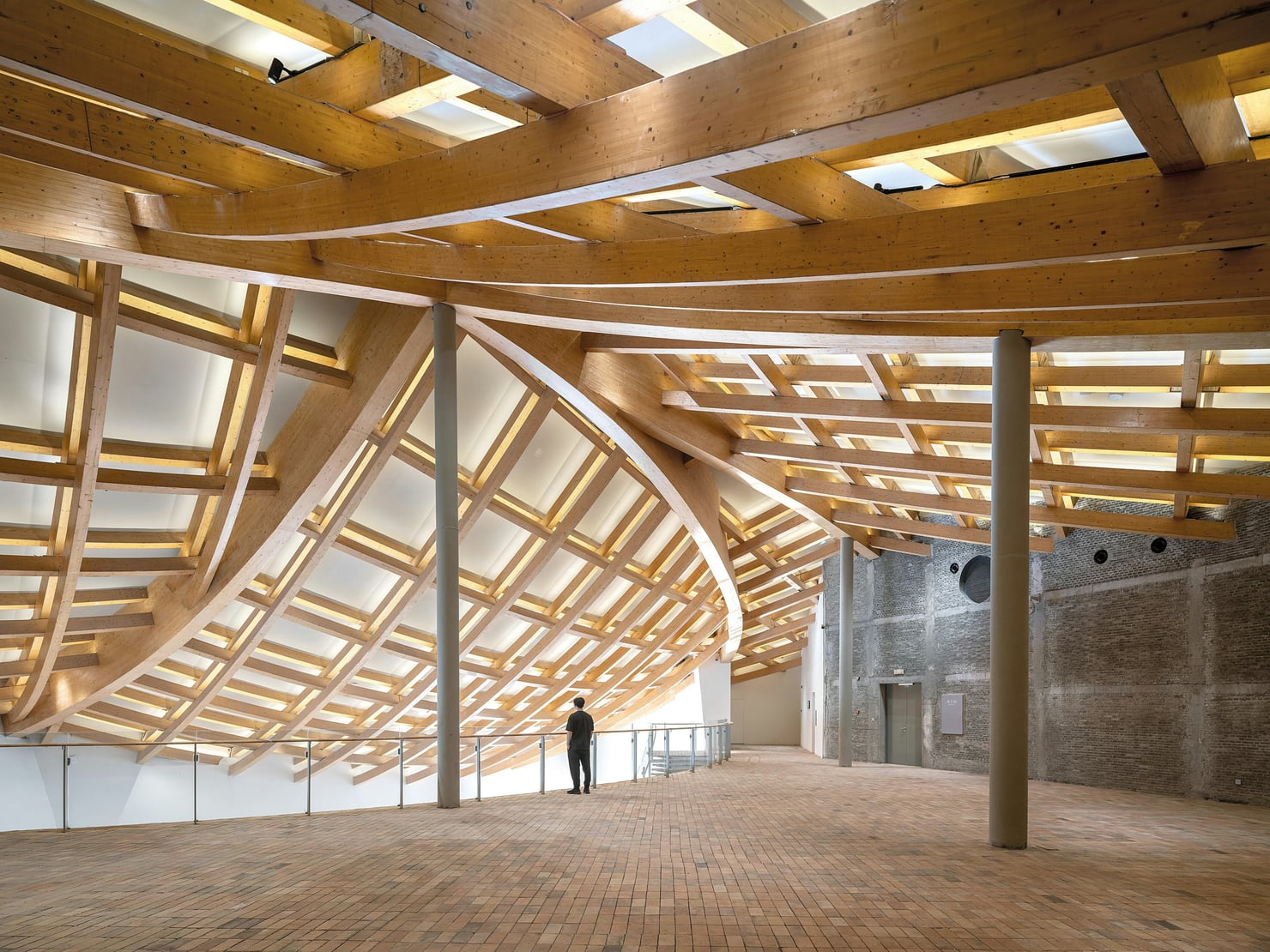
Design work on the UCCA Clay Museum began when the site had largely been cleared and no operator was yet in place. Yutaka Terasaki and Bao Mengxian of Kengo Kuma & Associates have described working without the detailed brief that would normally guide the design of a museum.
This does not mean the architects were unaware of the people who would use the building, or that their needs were overlooked. Nor is it possible to tell which decisions, if any, were directly shaped by the absence of an operator. The design did, however, take shape before some of the requirements for the museum’s future operation had been defined.
The architects looked to the surrounding area for other points of reference. In Yixing, in China’s Jiangsu province, ceramics are part of the city’s history and working life. The museum stands on land once occupied by factories and workshops, within a redevelopment scheme that preserves traces of the former industrial buildings and provides for new production and craft spaces.
According to Kengo Kuma & Associates, the building’s form draws on nearby Mount Shushan and traditional ‘dragon kilns’, built along a slope. Openings in the structure connect the museum visually with a ceramics factory and a canal, placing the new building in relation to its surroundings.
The façade also reflects the place in which it was made. Local craftspeople helped produce its ceramic panels, whose uneven surfaces and shifting colours change with the light. Their work makes ceramic production visible in the architecture, bringing knowledge rooted in the area into the building itself.
Opened in 2024, the UCCA Clay Museum presents exhibitions of contemporary ceramics by artists from China and elsewhere. Its relationship with Yixing runs through the works on display, the building’s materials and the area’s history of production.
The initial absence of an operator remains a significant part of the design process, but its effects on how the spaces are used cannot be assessed from the information available. What can be seen is how the local setting, ceramic techniques and collaboration with craftspeople gave the architects concrete points of reference at that stage.


