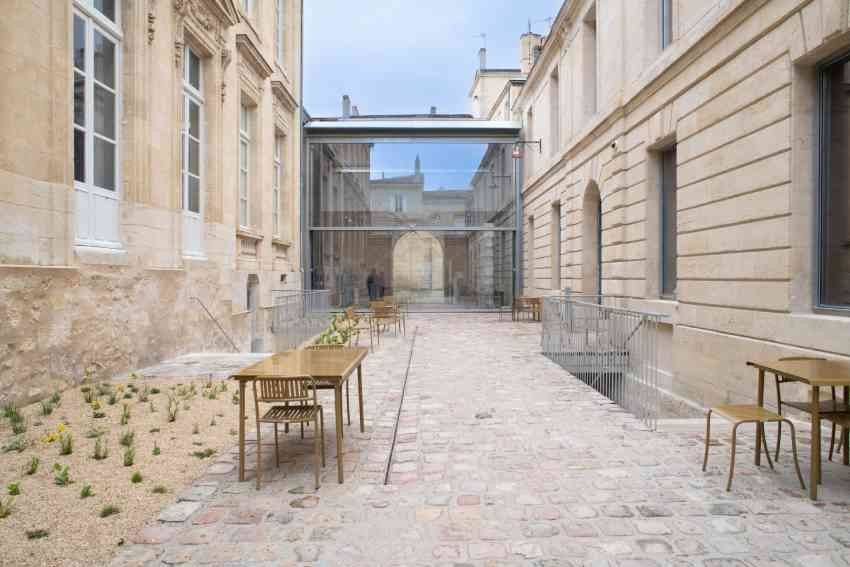
One door in the Musée des Arts Décoratifs et du Design in Bordeaux stays locked. It leads into the eighteenth century mansion where the oldest collections are kept, and it will not open until the end of 2027. Everything around it, though, has just come back to life after three years of work, and the choice its architects made says something rare about how to touch the past: they built as if they might have to take it all back.
The MADD occupies three buildings stitched together over two centuries: an aristocratic hôtel particulier, its old stables, and, since the 1980s, a former prison annexed for the museum's growing design collection. By the time renovation began, the spaces between them had thickened into dead ends, and the light had all but gone. 'Over the years, the empty spaces had filled in, the light had shrunk,' says architect Aymeric Antoine, whose firm led the project with Pierre Dufour. Their first move was to strip the interventions back to nothing, chasing light and volume rather than adding to what was already crowded.
What they added instead was steel, and they added it deliberately as a foreign material, not a disguise. New structural elements are grafted onto the historic fabric without a single direct fixing. 'Steel allows for a reversible intervention,' Antoine explains, as reported by Connaissance des Arts. 'If in twenty or thirty years someone wants to strip the place bare again, every element can be removed.' In the old prison courtyards, the technical ducting that museum conservation standards now demand is tucked along the edges and hidden from below by aluminium mason's rules, an almost invisible solution to an unglamorous problem. Meanwhile the old walls, with their flaking plaster and scratched graffiti, were simply left alone: an archaeological restraint that lets three centuries sit visibly next to each other instead of being smoothed into one.
The collection now moves through this in a deliberately uneven sequence: a room of eighty ceramic vases rising the full height of a hall, a gallery devoted to Bordeaux ceramicist René Buthaud, and a semi-permanent show, 'Céramiques, corps sensibles', built around an unusual premise, that the vocabulary we use for pottery, belly, neck, foot, lip, is the vocabulary of the human body, and that a glazed surface behaves like skin. Neolithic Egyptian pieces sit near work by Andrea Branzi under that idea.
The most personal room, though, belongs to Pauline Deltour, the French designer who died in 2021 at 38 after a decade producing 180 objects for fifty brands. Her retrospective fills the old prison cells with sketches, models, and a central table showing the range of her materials, but it is the borrowed objects that stop visitors: a set of pétanque balls, a toothpick dispenser, a child's chair, a carved wooden rabbit, each lent by a friend or relative she gave it to, each with a handwritten note beside it.
The locked door will open in 2027. Until then, Bordeaux has a museum that treats permanence itself as provisional, built to be unbuilt, in service of a past it refuses to erase.


