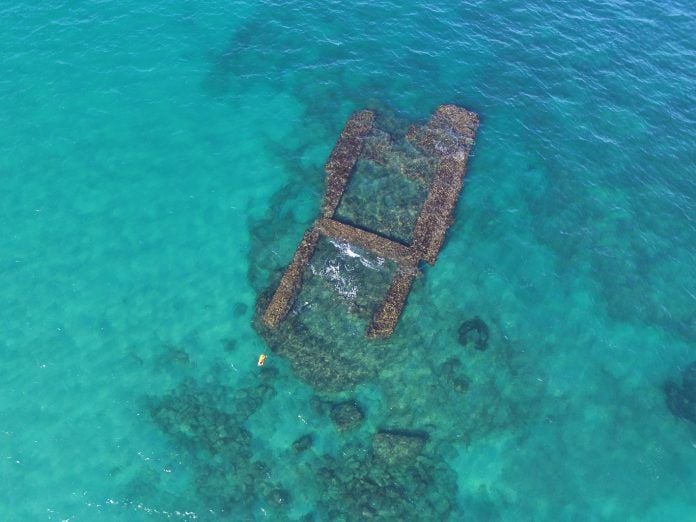
Under a few metres of water off the Salento coast lies the stone skeleton of a harbour that once handled ships bound for Rome. Divers went back into the water this week at Le Cesine, near Lecce, to resume digging at a site that could rewrite a small but pointed chapter of Roman history: the possibility that this is where the eighteen-year-old Gaius Octavius first set foot in Italy in 44 BC, after learning that his great-uncle Julius Caesar had been murdered and that he was named as his heir.
The campaign, running until 4 October, is led by the University of Salento's Department of Cultural Heritage under Rita Auriemma, working with Italy's Ministry of Culture and the local superintendency. The site sits within the WWF's Le Cesine nature reserve, in front of a disused pumping station called the Edificio Idrovoro, and what survives is mostly foundation work: a long straight mole reaching out from the ancient shoreline into a broader head, an L-shaped plan seen at low, sandy harbours across the Roman Mediterranean.
Ancient sources place Octavian's landing near Lupiae, today's Lecce, but nothing yet nails down this particular stretch of coast as the spot. That is exactly what this season's work is trying to settle: whether the harbour dates to the late Republic and early Augustan period, precisely the window in which a frightened young man with a famous name might have stepped ashore to change the course of Rome.
A second submerged structure to the north, nicknamed the 'Sunken Church' by locals who spotted its shapes beneath the waves, is now thought by archaeologists to be a tower or lighthouse tied to the harbour system, not a chapel at all. On land, a large plastered basin found in 2025 may have been used for salting fish, given its proximity to the old salt pans, or for making wine on a Roman farm estate.
This year also brings the Acaya LandLivingLab, a new conservation and study space inside Acaya Castle where finds will be catalogued and shown to the public through open days and school visits. As Auriemma puts it, the aim is to bring people to the heritage, not the other way round.
Whether or not Octavian's sandals ever touched this particular mole, the harbour itself is a rare thing: a working piece of Roman infrastructure, waiting under Adriatic sand for someone to finish reading it.


