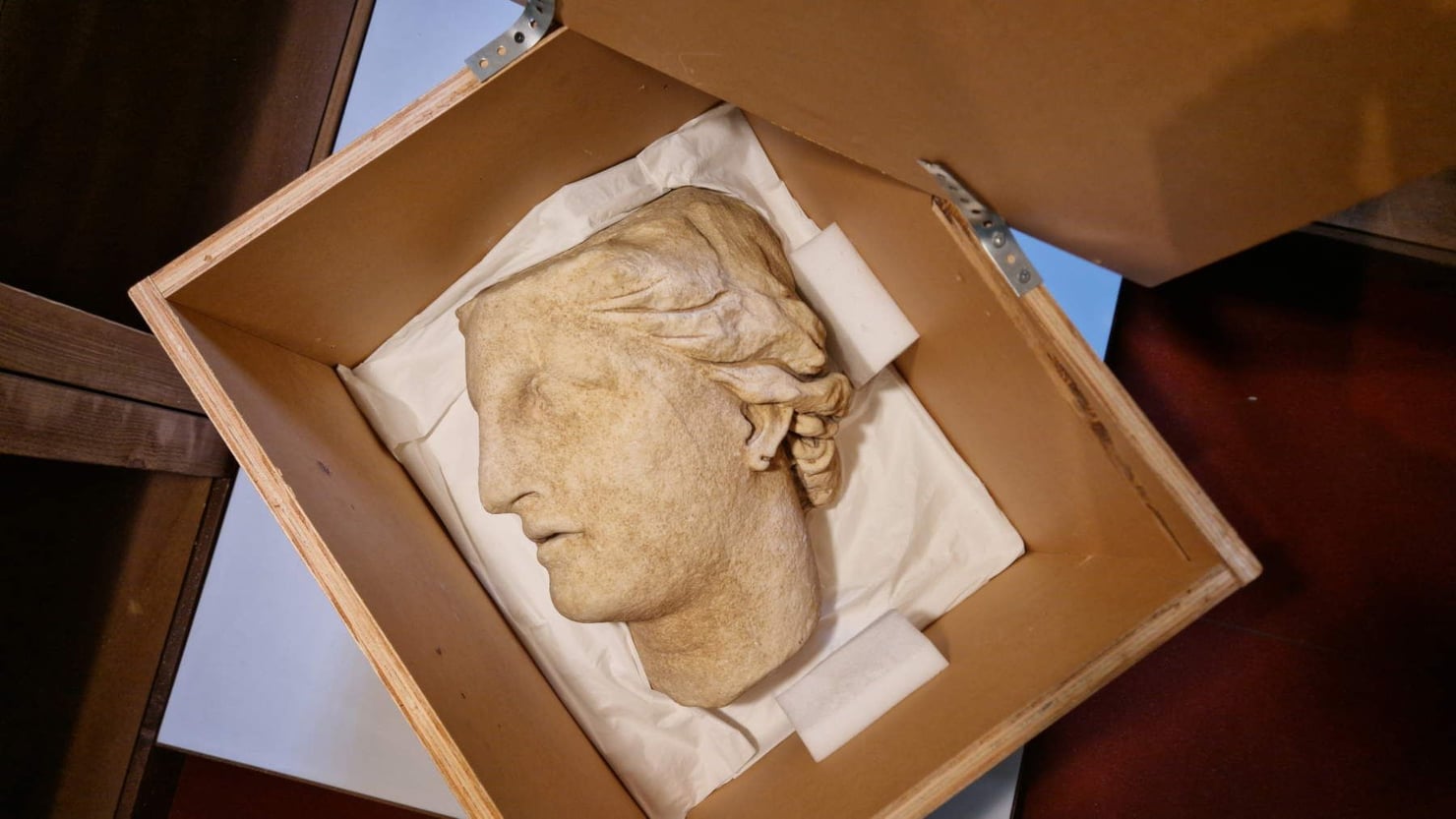
A marble head of Athena stands in Taranto with a hollow carved into her skull, the socket once fitted with a helmet in bronze or marble. Nobody can say exactly where she stood when she was whole. She was probably a votive image of the goddess, life size or larger, set up outdoors sometime between the late third and second century BC. Then she vanished into the market, and reappeared decades later in the storerooms of the Metropolitan Museum of New York, one line in a much longer ledger of loss.
On 16 December, the Museo Archeologico Nazionale di Taranto opened Memorie trafugate (Stolen Memories), a show built around twenty objects recovered by Italy's Carabinieri Tutela Patrimonio Culturale and repatriated from the Met. Alongside the Athena head there is a fragment of wall painting that seems to show a symposium scene, bronze brooches dated as far back as 325 BC, sixth century BC rings, bronze ornaments inlaid with gold, terracotta and soft stone reliefs. And, tucked among the genuine antiquities, one confirmed fake: a reproduction of an epichysis, a spouted jug in the Gnathia style, good enough to pass for the real thing until someone looked closely enough.
All of it traces back to Robin Symes, the London dealer whose company, Symes Ltd, funnelled looted antiquities into the world's most respected museums for decades, many of which had no idea what they were buying. The Carabinieri's investigation into that network, launched in the early 2000s, has so far brought roughly 750 objects back to Italy. This shipment from the Met is the latest instalment.
What makes Taranto's exhibition unusual is what it refuses to do. It does not label each piece with a tidy caption and move on, because it cannot. Most of these objects arrived with no excavation records, no findspot, sometimes no century. Many bear traces of restoration carried out purely to make them more saleable, alterations that now stand between the objects and the truth of what they are. Only a handful, the Athena head among them, can be provisionally placed in time and context. For the rest, the museum says plainly: any conclusion right now would be premature.
So the show becomes a demonstration of method instead of a gallery of trophies. Visitors see how conservators log an object's form and condition, how typological comparison offers first clues to origin, how archaeometric analysis of materials and technique can expose a deceptive restoration or a modern forgery hiding behind ancient styling. It is less a triumphant homecoming than an admission: these things were stolen not only from Italy, but from their own histories, and getting that history back may take years, or may never fully happen.
Stella Falzone, the museum's director, put it starkly at the press conference: many of these objects were reworked purely for aesthetic appeal, stripped of the culture that made them, and now they have to be taught to speak again. She credited the Met itself with cooperating fully and overhauling its acquisition practices, a detail that matters as much as the objects: this is what accountability looks like after the fact, one marble head at a time.
The Athena's helmet is still missing. So is almost everything else about her.


