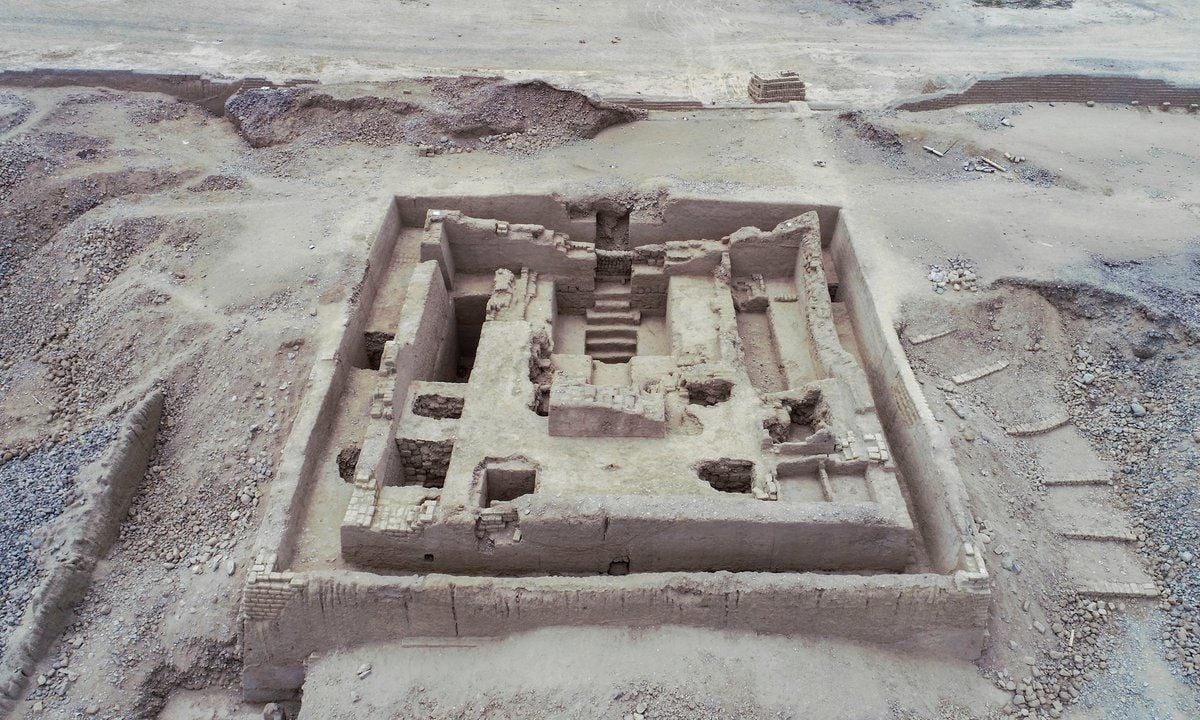
At Chan Chan, the former capital of the Chimú kingdom on Peru’s northern coast, archaeologists have discovered a largely intact funerary platform. In the Utzh An complex, human remains and many of the objects associated with them were documented still in relation to the spaces in which they had been placed.
The structure includes a central chamber and two lateral chambers. So far, 20 individuals have been recorded in one of the lateral chambers; the other contained weapons and metal emblems but no human remains. A further 18 people were found in different parts of the platform. One of them had been placed in the central chamber together with objects made of shell and metal.
Around and above the skeletons, archaeologists found ear ornaments, necklaces made of shell and quartz, headdresses, and carved wooden boxes with metal applications. Red pigment was also recorded on some of the individuals and on several ceramic objects. According to Peru’s Ministry of Culture, these materials indicate that the people buried there belonged to high-status sectors of Chimú society.
One burial differs from the others: the body was laid out fully extended, whereas crouched or seated positions are more common in known Chimú funerary contexts. Archaeologists are considering several possible explanations, including differences in status or the circumstances of the person’s death. Sacrifice has also been suggested as one possibility, but the position of the body alone is not enough to establish this.
The importance of the discovery lies above all in the possibility of studying human remains, objects and spaces together rather than as separate elements. The relationships between them may help researchers reconstruct how the funerary context was organised and better understand the practices associated with burial.
Excavations will continue until 2027. Further analysis may provide information about the age, diet and possible biological relationships of the people buried there. These findings may also help explain differences between the burials, including the unusual position of the extended body.


