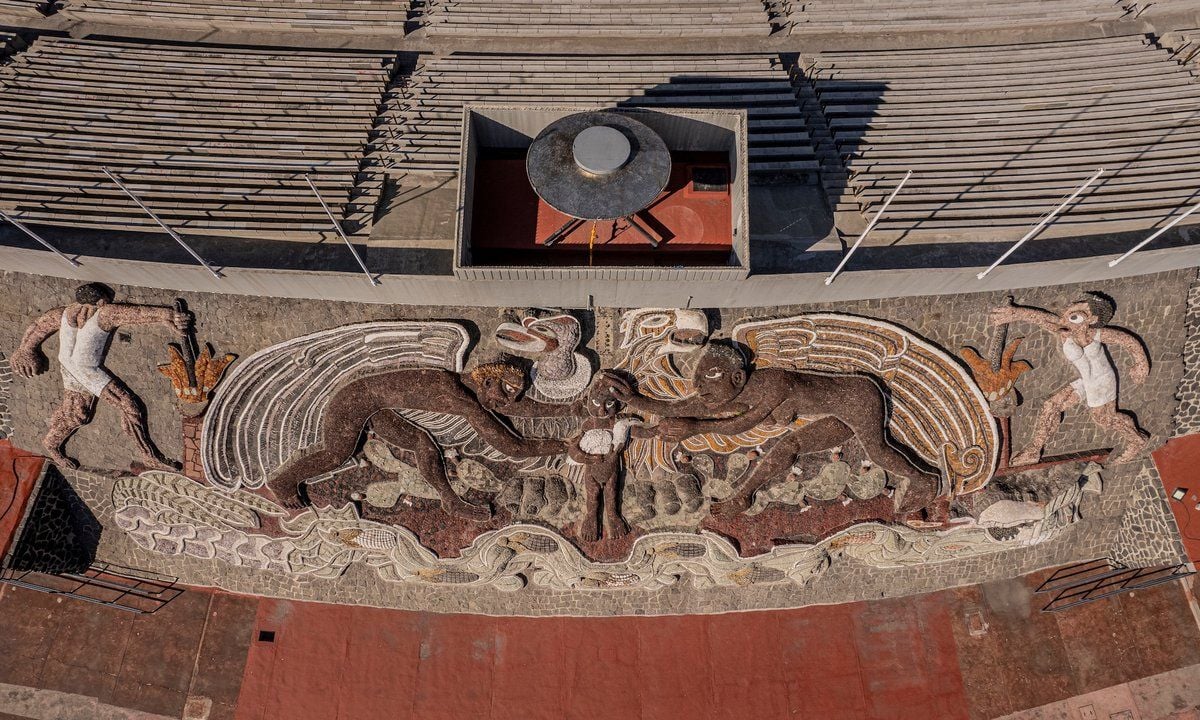
Volcanic stone, river pebbles and marble form Diego Rivera’s relief on the sloping wall of UNAM’s Olympic Stadium. Fixed directly to the masonry with cement, they present an early question for conservators: how do these materials interact with the wall that supports them?
The relief will be the first work addressed by a multi-year programme launched by the World Monuments Fund and the Universidad Nacional Autónoma de México (UNAM). Its conservation is funded through Freedom 250, a programme of the US government’s Ambassadors Fund for Cultural Preservation. The collaboration will later extend to other works on the campus.
The stadium stands on UNAM’s central campus, which UNESCO designated a World Heritage Site in 2007. The complex was designed around the principle of ‘plastic integration’, bringing art, architecture and space into a single conception. As Mónica Cejudo Collera, who oversees architecture at the university, explains, the artworks were conceived alongside the buildings rather than added after construction.
La universidad, la familia y el deporte en México depicts a family sheltered by an eagle and a condor, the feathered serpent Quetzalcoatl, and two athletes carrying Olympic torches. What Rivera completed was part of a larger plan to cover the stadium’s exterior walls with a history of sport, from pre-Hispanic times to the present. That plan remained unfinished.
Rivera applied natural stones of different colours directly to the masonry. Renato González Mello, a scholar of Mexican muralism at UNAM, says there is still much to learn about the materials and techniques used in the work.
Historical, scientific and material investigations will therefore help determine how best to stabilise and conserve the relief.


