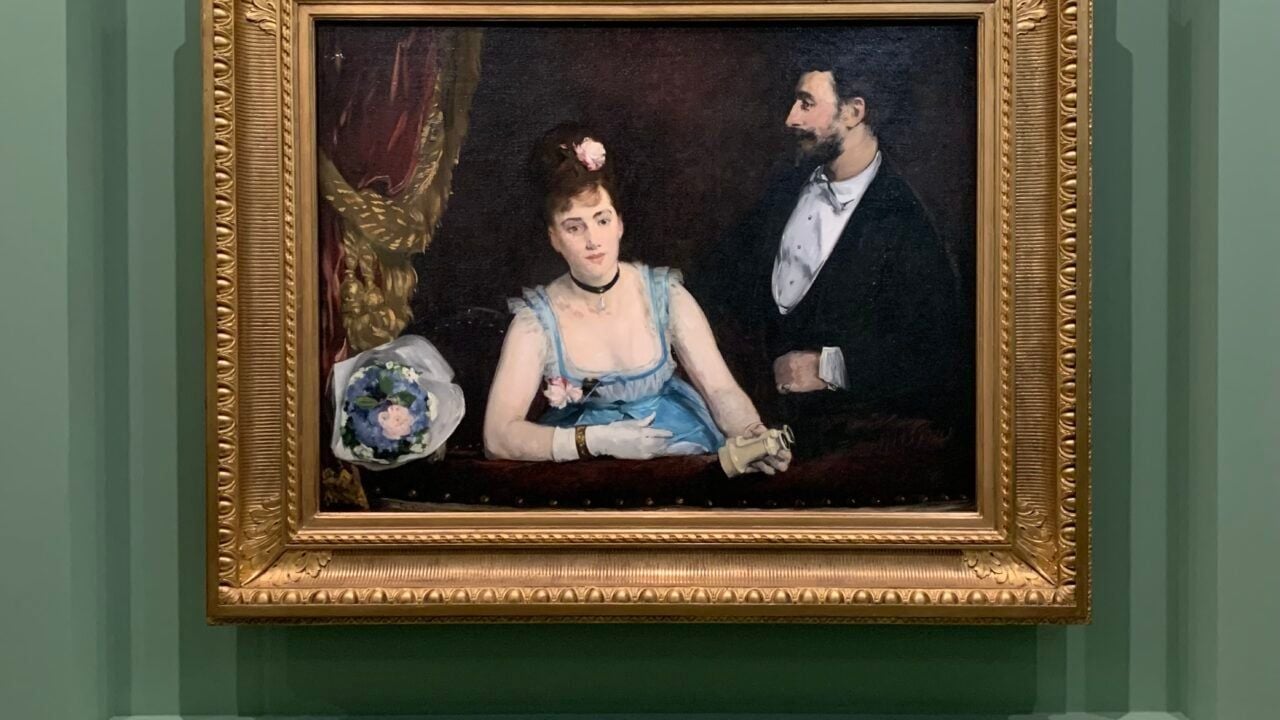
The jury of the Salon, Paris’s official art exhibition, rejected Eva Gonzalès’s Une loge aux Italiens in 1874. The painting shows her sister Jeanne in a theatre box. That same year, the Salon accepted her pastel La Nichée, which met with considerable success. Gonzalès submitted the rejected painting again in 1879, and this time it was accepted.
In Une loge aux Italiens, Jeanne appears beside the painter and printmaker Henri Guérard, whom Gonzalès married in 1879. Gonzalès chose to depict people attending the Théâtre des Italiens, bringing a scene of Parisian social life onto the canvas.
These episodes form part of Eva Gonzalès. Parcours d’une artiste libre, at the Petit Palais from 15 September 2026 to 24 January 2027. Bringing together nearly 100 paintings, pastels and prints, the exhibition follows Gonzalès’s career chronologically.
Born in Paris in 1847, Gonzalès could not enrol at the École des Beaux-Arts. Women were not allowed to sit its entrance examinations until 1897, fourteen years after her death. Her family supported her private training, first in Charles Chaplin’s studio and then, from 1869, with Édouard Manet. She became Manet’s only official pupil.
Family support did not remove the social expectations placed on a young woman. In 1868, when Gonzalès planned to rent a studio, Chaplin considered the choice inappropriate for an unmarried woman. She had already left his studio in May of the previous year.
Gonzalès went on to exhibit regularly at the Salon, though she did not take part in the Impressionist group’s exhibitions. Her relationship with Manet remained part of her working life, but the exhibition also follows the development of her painting through interiors, portraits and landscapes of the Normandy coast.
Jeanne’s face recurs across the works on display, from the theatre box to domestic interiors and scenes of her getting ready and dressing. Gonzalès’s sister, pupil and confidante was also one of her principal models. Drawing on the same face for different figures, Gonzalès built scenes of everyday life around her.