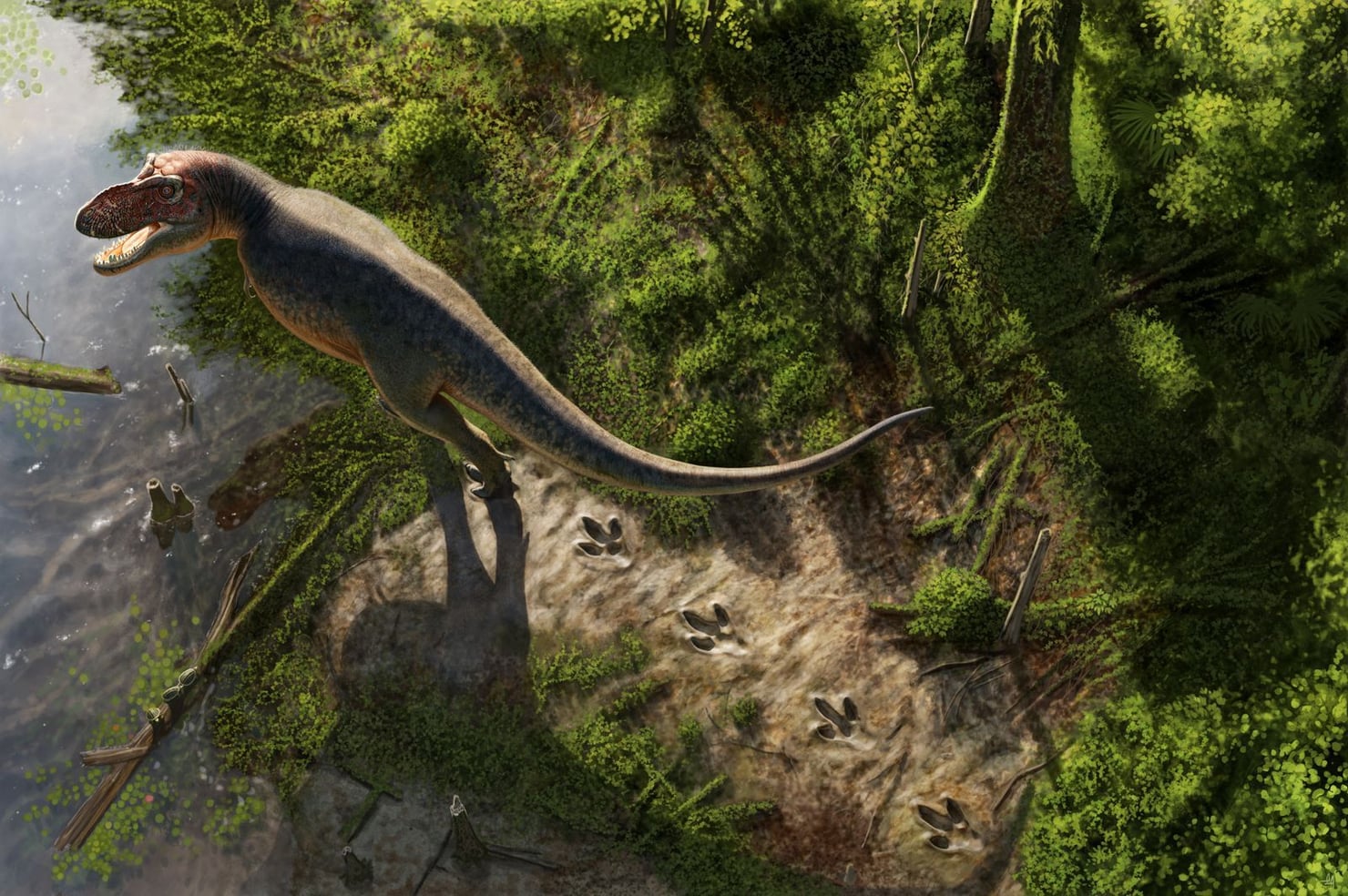
In 2025, Kent Hups, a science teacher, was volunteering on an excavation in the Hell Creek Formation in south-western North Dakota when he noticed the shape of a large, three-toed foot. Examining the surface revealed three more footprints: two from the right foot and two from the left.
The tracks are around one metre long and eighty centimetres wide, and date from the end of the Cretaceous period. Their size and location make an adult Tyrannosaurus rex the most likely maker. The identification is not definitive, because erosion has removed many anatomical details. Even so, the trackway is unusually informative. Until now, only isolated footprints had been associated with adult T. rex.
The sequence offers clues about how the animal moved. The distance between successive prints made by the same foot is around four metres, suggesting a speed of between 5.5 and seven kilometres per hour, consistent with a walking pace. One of the footprints also appears to preserve the mark of a claw.
The way the tracks were preserved is equally distinctive. Sediment filled the depressions left in the mud, then hardened more than the surrounding rock through microbial activity and the accumulation of minerals. As erosion wore away the surrounding material, the footprints emerged as three-dimensional raised forms rather than hollows.
The research team, led by palaeontologist Tyler Lyson of the Denver Museum of Nature & Science, documented the trackway using high-resolution three-dimensional scans. The digital models make it possible to examine and compare the footprints, and to create reproductions without interfering with the originals. Three of the tracks are expected to be transported by helicopter to the museum in autumn 2026, where they can be protected and studied further.
Bones show what an animal was made like. Footprints preserve an action. These four tracks cannot establish how every T. rex walked, but they record moments in the life of one individual: its passage across muddy ground 66.5 million years ago.


