An ivory female figurine made in the Indian subcontinent reached Pompeii before the eruption of AD 79. The distance between its place of manufacture and its findspot makes it one of the cases explored in Global Antiquity, Fondazione Prada’s exhibition in Milan on the artistic, commercial, cultural and political connections of the ancient world.
Running from 5 November 2026 to 1 March 2027, the exhibition is curated by Salvatore Settis, Anna Anguissola and Chiara Ballestrazzi. It brings together more than 150 artworks and objects, focusing primarily on the period from around 600 BC to AD 1000 and the relationships between Mediterranean and Asian cultures.
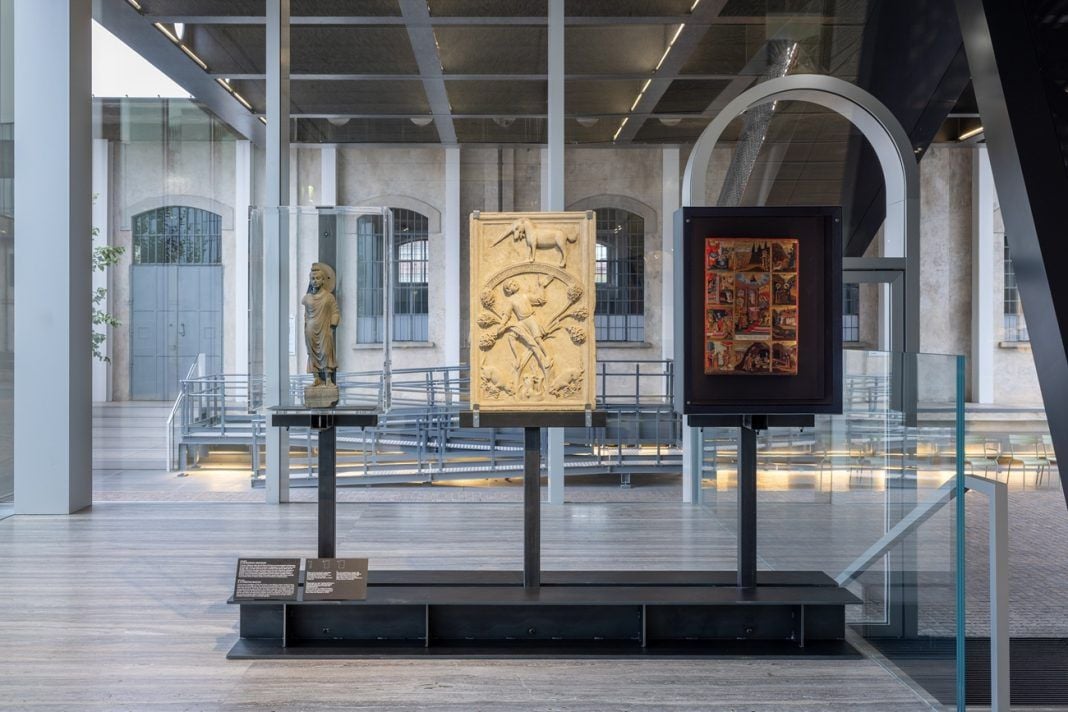
Objects are grouped according to similarities in form, materials and imagery rather than a single geographical or chronological sequence. A ninth-century Iraqi astrolabe appears alongside an Andalusian example made two centuries later. A second-century gold reliquary from the Buddhist stupa at Ahinposh, in present-day Afghanistan, is displayed near the Roman and local coins it contained.
Connections can also be traced through the materials of a single object. A small casket found at Belmonte Piceno, in Italy’s Marche region, and made between 560 and 540 BC combines ivory brought through the eastern Mediterranean with amber from the Baltic. Its Greek and Etruscan imagery brings these trading networks into contact with the cultural traditions of ancient Picenum.
Other comparisons address questions that remain open. One section examines the possible Chinese origin of the head of Venice’s Lion of Saint Mark, placing it within the wider context of artistic and cultural exchanges over long distances.
In the curators’ interpretation, ancient “globality” describes a network of exchanges and reciprocal influences, distinct from modern globalisation. Rem Koolhaas and AMO/OMA’s exhibition design translates this approach into groups of objects placed in relation to one another within the Podium.
Throughout the exhibition, where an object was found matters as much as where it was made. Reconstructing the relationship between these places helps trace its circulation, while studying its materials and imagery reveals the different cultural traditions that contributed to its creation.