At Angola prison in Louisiana, Gary Tyler made quilts for people receiving palliative care. After each person died, the quilt was given to their family. Looking back, the artist says: ‘I realised we were making something that would stay in the family for generations.’
His work is the focus of one of three solo exhibitions that opened on 3 October at the Grand Rapids Art Museum in Michigan. The others are devoted to Julie Green and Ray Materson. Tyler and Materson developed their techniques while in prison; Green worked outside prison, documenting the last meals requested by people sentenced to death in the United States.
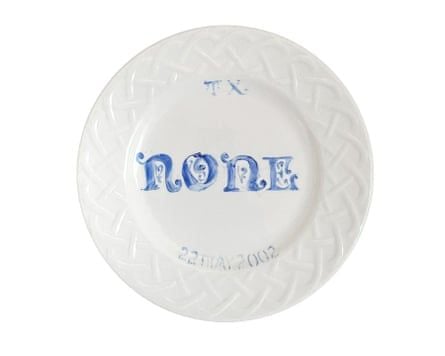
For 22 years, Green painted those meals on reclaimed ceramic plates. The series, The Last Supper, comprises nearly a thousand plates. Some bear only the word ‘none’, indicating that the person had chosen not to eat. Others recall moments shared with family: food bought from a vending machine and eaten together, or a dish cooked by a mother who had been allowed to visit.
Materson began embroidering during the seven years he spent in prison. He unravelled socks to obtain coloured threads, which he used to make miniature scenes. Other people in prison asked him for portraits of loved ones, sports patches and national flags: images of people, interests and places that mattered to them.
Tyler’s quilts began as part of his work caring for others in prison, but also became a way to tell his own story. One depicts him leaving a courthouse in handcuffs as his supporters applaud. He was released in 2016 after more than four decades in prison.
Green’s exhibition runs until 24 October 2027; Tyler’s and Materson’s close on 3 January 2027.
The quilts given to families, the shared meals recalled on plates and the portraits embroidered for others in prison show different ways people kept a connection with those close to them.