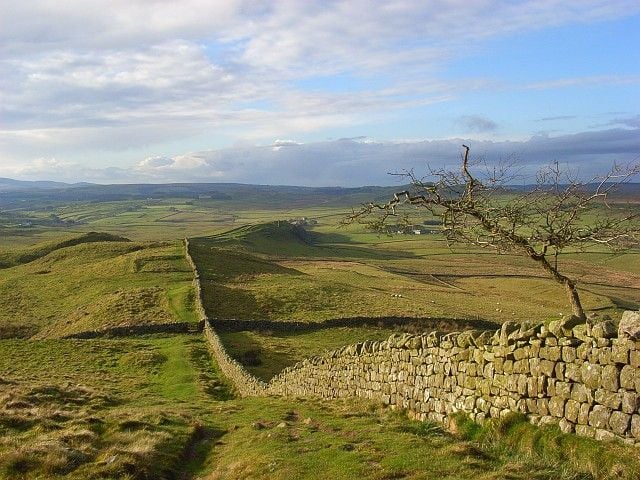
Over time, some gates in the milecastles and forts of Hadrian’s Wall were closed. The fortification remained, but the places where people could cross it changed. For archaeologist Andrew Gardner, those closures are one reason the Wall cannot be assigned a single, unchanging purpose.
Gardner examines the evidence from the Wall and its surroundings in a 2022 article published in the journal Britannia.
Construction began in AD 122. Built partly of stone and partly of earth and turf, the fortification crossed northern Britain. Its wall, towers, milecastles and forts formed part of a wider system within an extensive militarised zone.
The design changed even while construction was under way. Later, the closure of some gates in the milecastles and forts altered where people could pass through the fortification.
The surrounding landscape also bears traces of the frontier. Archaeological research has documented substantial changes in the distribution of settlements across the Northumberland Plain. Communities north and south of the Wall, and close beside it, changed during the Roman period.
The frontier imposed divisions and controlled crossings, but it did not prevent every connection. Civilian settlements near the forts linked military communities to wider social networks. At some forts, market activity continued after those settlements were abandoned, while some objects travelled in both directions across the frontier zone.
Hadrian’s Wall did not follow today’s border between England and Scotland, nor was it always the northernmost limit of Roman Britain. To picture it as a single, solid barrier is to give it a permanence its history does not support.
Closed gates, shifting settlement patterns and continuing activity around some forts show how the frontier’s role changed over time. The fortification remained, but its points of access and its relationship with the surrounding area did not stay the same.