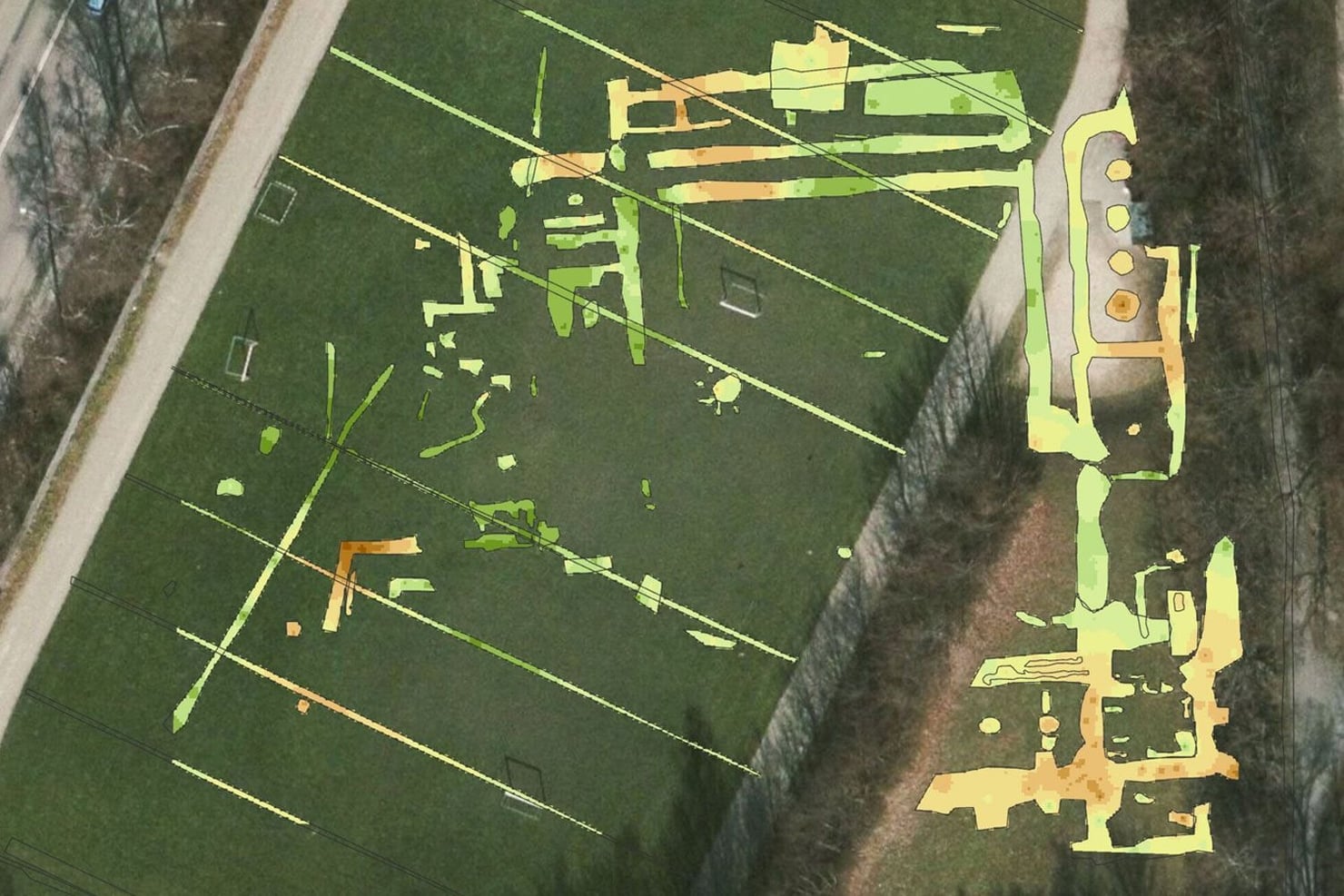
About a metre beneath a football pitch in Byparken, Roskilde, georadar has made the plan of a medieval convent visible again. Rooms, cloisters, pillars and a church now appear as traces of the convent of Saint Clare, a complex once thought to have been almost entirely lost.
Founded in 1256 for the Poor Clares, the convent was one of five monastic communities in medieval Roskilde. At the time, the Danish town was a major centre of ecclesiastical and royal power. The convent was suppressed and demolished after the Protestant Reformation. Around half a million bricks were sold to nearby Selsø Castle, leading researchers to believe that little of the original structure remained underground.
The investigation began because of a possible plan to build an underground car park. ROMU, the National Museum of Denmark and the Norwegian Institute for Cultural Heritage Research used georadar to establish what survived without immediately resorting to excavation. The technique sends radar pulses into the ground and records the reflections produced by buried structures and changes in the soil.
The survey reveals four wings arranged around a courtyard. The church occupied the southern side of the complex. In the eastern wing, internal divisions and the foundations of pillars can be distinguished. Archaeologist Jesper Langkilde has suggested that the nuns may have attended services from a raised space separated from the other worshippers. That interpretation will need to be tested through direct archaeological investigation.
The survival of the remains is partly the result of what happened after the convent was demolished. No new buildings were constructed on the site, which has been used as a football pitch since 1961. The recent use of the land may therefore have helped preserve traces of the medieval complex beneath it.
The new information will help researchers choose more precisely where to open test trenches and how to protect the best-preserved parts of the site. Pottery, animal bones, religious objects and burials could reveal not only how the buildings were organised, but also more about the people who lived there.
Georadar has not brought the convent back through excavation. It has done something more measured and, for the site, just as important: it has shown that a substantial part of the complex may still survive beneath the surface, and provided a clearer basis for studying and preserving it.


