In the Guerrilla Girls, Joyce Kozloff was known as Liubov Popova. She used the name of the late Russian artist while keeping her own identity hidden. In an interview with Helena Reckitt and Maura Reilly, published on 23 July 2026, she spoke publicly about this part of her work.
In 1985, two younger artists invited her to a meeting to start a new feminist project. The first group had seven members. Kozloff stayed until 1991 and supported anonymity for a particular reason: she wanted the issues they raised to receive the attention. For her, avoiding possible professional repercussions was not the reason for the choice.
The collective emerged amid protests over the limited representation of women in art institutions. Some of its future founders had taken part in a 1984 demonstration against an exhibition at New York’s Museum of Modern Art. The Guerrilla Girls later took their protest into the streets with posters combining statistics, humour and bold graphics. Gorilla masks and pseudonyms made the group recognisable without revealing individual identities.
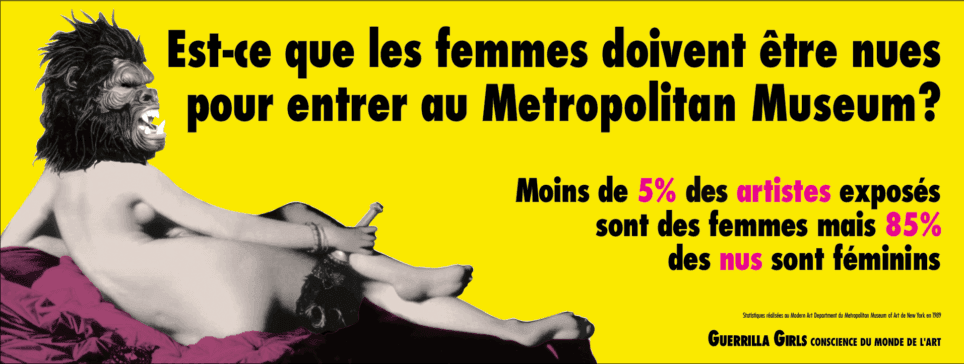
A poster that appeared on New York buses in 1989 asked whether women had to be naked to get into the Metropolitan Museum. Beside an image of Ingres’s Grande Odalisque with a gorilla head were two figures gathered by the group: in the modern art sections, fewer than 5% of the artists were women, while 85% of the nudes depicted women. The poster set the prominence of women’s bodies in artworks against the limited recognition of women as artists.
Kozloff also recalls writing an early draft about the ‘disadvantages’ of being a woman artist. Other members turned the wording around, and The Advantages of Being a Woman Artist was published in 1988.
Her account offers a glimpse of how the collective worked: one person’s proposal could be discussed and reshaped together. In this case, changing ‘disadvantages’ to ‘advantages’ made irony central to the criticism.