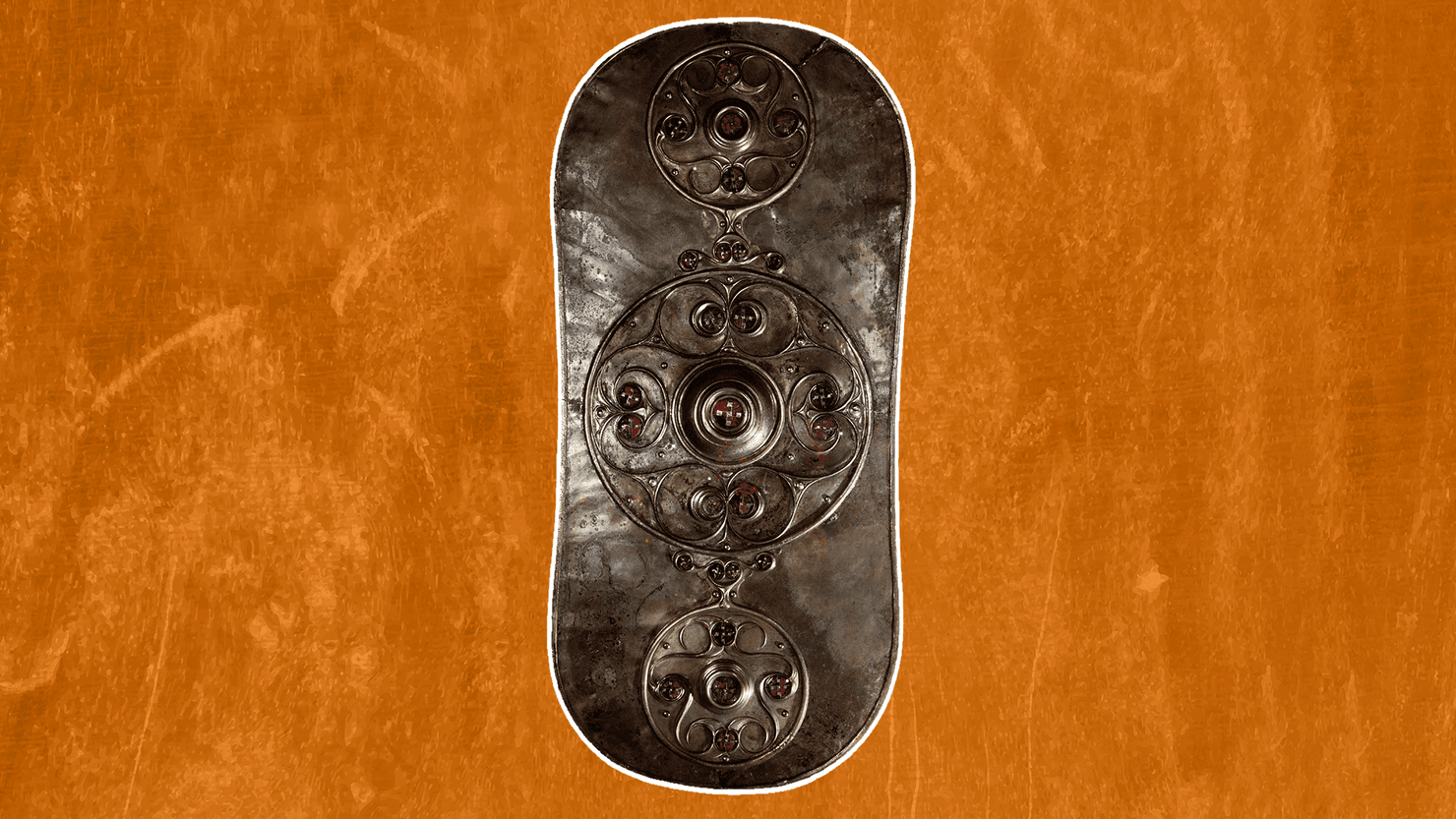
A worker building a bridge over the Thames found what is now known as the Battersea Shield. The name suggests a complete shield, but the object held by the British Museum is its metal facing. The wooden support it once covered has been lost. Understanding how the shield was used means reckoning with that missing part.
The museum dates the facing to about 350 to 50 BC. It consists of four bronze sheets and three decorated panels, joined by rivets concealed beneath overlapping metal. At its centre is a raised boss, positioned above the handgrip to protect the hand. Its shape is characteristic of shields from Britain, making local production highly probable in the British Museum’s view.
The decoration shows how carefully the bronze was worked. Craftspeople hammered it from behind to raise the designs on the front, a technique known as repoussé. Engraved and dotted marks bring out the patterns, while 27 insets of opaque red glass complete them. The principal forms are palmettes and interlacing S-shaped motifs.
The shield’s use is harder to reconstruct. In a conversation with Kate Sumnall of London Museum, Adams notes that the absence of damage associated with combat may suggest it was not used in battle, though it does not rule out that possibility. One explanation for its presence in the Thames is that it was placed there as an offering to the river, or to mark the death of an important person.
Ritual deposition remains a possibility, not an established explanation. The surviving facing tells us a great deal about how the shield was made, but it cannot yet tell us how it was used or why it was left in the Thames.


