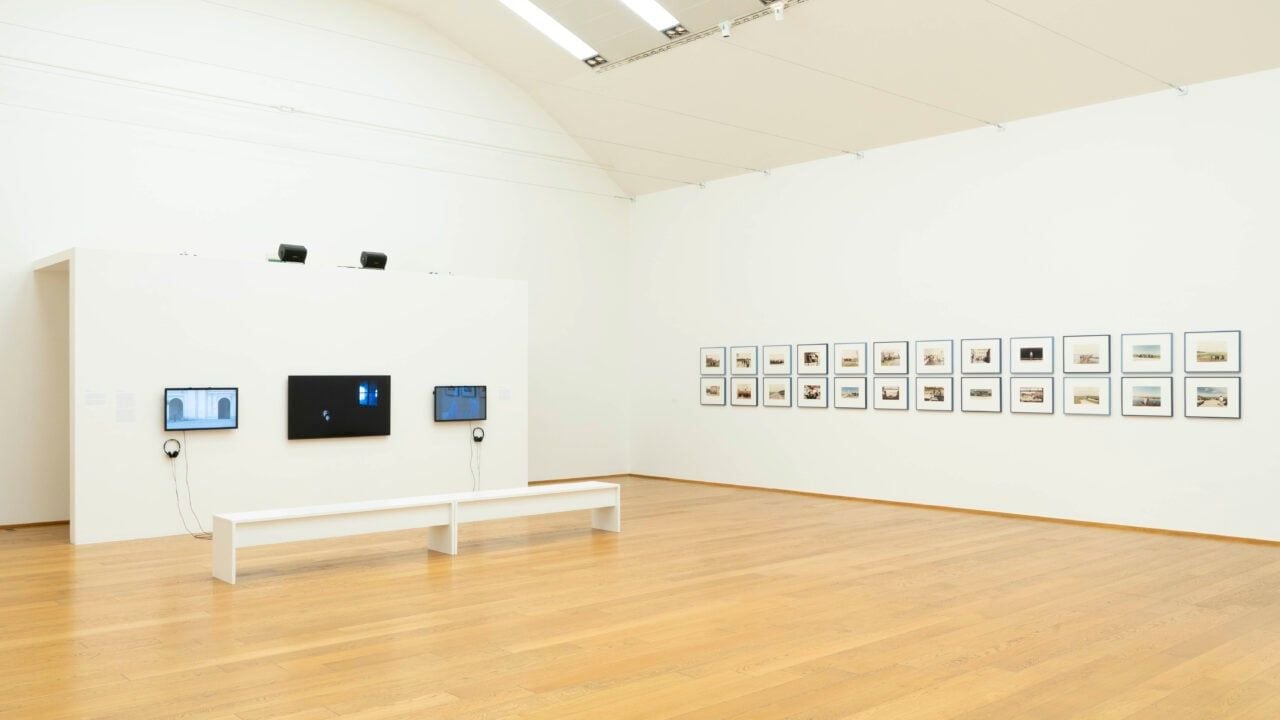
In MAMbo’s project room in Bologna, 81 photographs follow roads, embankments and pauses between Ferrara and the Po Delta. Luigi Ghirri made them between 1989 and 1991, while accompanying Gianni Celati, a writer, filmmaker, critic and translator, during the development of Strada provinciale delle anime. The exhibition Luigi Ghirri e Gianni Celati. Verso la foce, on view until 4 October 2026, places these images beside the film’s sound. The landscape emerges through still pictures, moving images and voices.
Curated by Lorenzo Balbi and Giulia Pezzoli, the exhibition is not simply about a friendship between two important figures. In the curators’ account, that relationship made possible a particular way of approaching the landscape, based on attention, pauses and shared observation. The exhibition follows a collaboration, but also makes its working method visible.
Ghirri and Celati first came into contact in 1981. Between 1989 and 1991, their dialogue took one of its most intense forms. Celati had published Verso la foce in 1989, a book that grew from his exploration of the landscape along the Po. The same exploration developed cinematographically into his first feature film, Strada provinciale delle anime. Ghirri joined the project from its earliest site visits, photographing the places and people encountered along the route.
The result, represented in the exhibition by the series Blu infinito, does not present Ghirri as a detached observer documenting another person’s work. The curators describe him as taking part in the creative process, accompanying the film from its first visits and contributing almost as a stills photographer and location manager. His compositions and attention to light remain recognisable, but the photographs also give greater space to faces, gestures and groups travelling together. The institution describes them as fixing the film’s genesis and revealing a new, intense attention to the human figure. The landscape is not empty scenery. It is where encounters take place.
The route passes through Migliarino, Codigoro, Comacchio, Gorino and other locations between Ferrara and the river’s mouth. Long stops on roads and embankments become part of the work. In the curators’ interpretation, the journey matters less as a route towards a final destination than as a reason to remain in a territory long enough to notice it.
During the visit, the audio of Celati’s film continues to play among the photographs. Voices belonging to Celati, Ghirri, the actors and the crew form a sonic counterpoint to the still images. The curators say this arrangement allows the relationship between the two works to be perceived: a photograph holds a moment, while a film carries voices, movement and duration. Together, they present a landscape through several kinds of attention.
The curators also connect the work to places that change or seem to disappear. In Ghirri and Celati’s approach, ordinary and peripheral landscapes contain the meeting of nature and culture, as well as the traces of transformation. Celati later wrote about the risk that places with distinctive local character might become indistinguishable from the non-places of the world.
That gives the exhibition its present significance. It does not turn the Delta into a symbol or offer a nostalgic portrait of a disappearing country. Instead, it shows what can become legible when attention is given to roads, voices, people and places that usually escape the hierarchy of the exceptional. The project room preserves a moment of collaboration, while inviting visitors to consider how a territory becomes knowledge through time spent looking.


