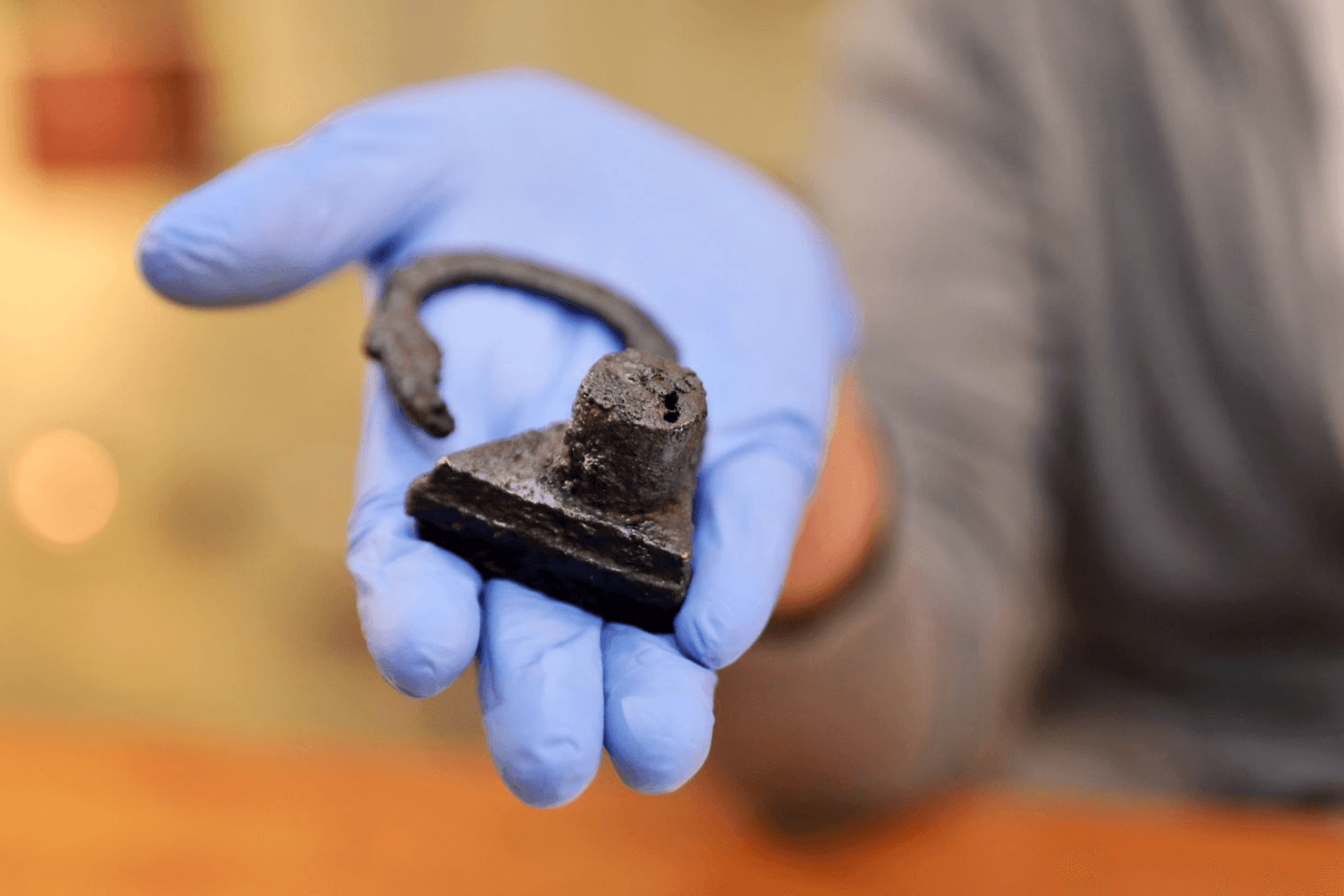
A padlock, triangular and small, clamped around the big toe of a dead woman's left foot. An iron sickle laid across her throat, blade turned inward, edge pressed toward the skin as if still cutting. Two separate acts, done at two separate times, by people who buried a young woman in what is now Pień, Poland, sometime in the mid-1600s and then came back.
That is the detail that stops you: they came back. Whoever placed the lock did so at burial. Whoever placed the sickle returned to the grave later, opened it again, and laid the blade across her neck facing her, not away from her. Dariusz Poliński, the archaeologist from Poland's Nicolaus Copernicus University who has led the investigation since the grave was found in 2022, put it plainly to CNN: two precautions meant the fear was greater than usual. This was not one nervous gesture. It was a community that tried something, decided it wasn't enough, and tried again.
They call her Zosia now. Nobody knows her real name, how she died, or precisely what she was accused of. What the team, publishing this year in the Journal of Archaeological Science: Reports, has managed to piece together after four years of analysis is almost stranger than the ritual itself. Traces of copper, manganese and gold turned up on her palate, hinting that something, still unidentified, was placed in her mouth or nose after death, a third safeguard nobody has yet named. And on her skull: threads of silk, gold-woven, the remains of an expensive cap trim. Zosia was not a beggar or an unknown drifter. She was likely a noblewoman, buried among the poor and the disgraced on what researchers now believe was unconsecrated ground, set apart from any church.
That contradiction is the story. Someone with money, status, fine imported cloth on her head, ended up locked and bladed into a grave reserved for outcasts. Poliński's own theory, offered in a 2024 statement, is that a tragedy befell her and she was harmed, or that something about her appearance or behaviour made her neighbours afraid. In the seventeenth century, that fear needed no proof. Outsiders, heretics, orphans, women who died in childbirth or by their own hand: any of them could be labelled demonic, a category modern reporting flattens into 'vampire', a word that did not even exist in general use until a century later. The Pień cemetery has yielded more than a dozen such graves among 101 examined so far, including a child buried facedown with a padlock beneath its foot, and skeletons pinned under stones. Across Europe, similar burials have surfaced in Italy, where a woman was found with a brick wedged in her mouth, and in Bulgaria, where men were staked through the chest.
What still nags is the gap between the two objects. A padlock on a toe is subtle, almost bureaucratic: a fastening, a note that says stay. A sickle across a throat, blade inward, is a threat with an edge. Somewhere between those two visits to Grave 75, the fear changed shape. In 2024 the sculptor Oscar Nilsson built her face back from the bones: blue eyes, light brown hair, a broad nose, a young woman who looks, in the reconstruction, entirely ordinary. 'These people burying her did everything they could to prevent her from coming back,' Nilsson told Reuters. 'We have done everything we can to bring her back to life.' Her cause of death is still unknown. So is whether she was born near Pień or arrived there as a teenager, into a village that would, not long after, decide it needed to lock her down twice.


