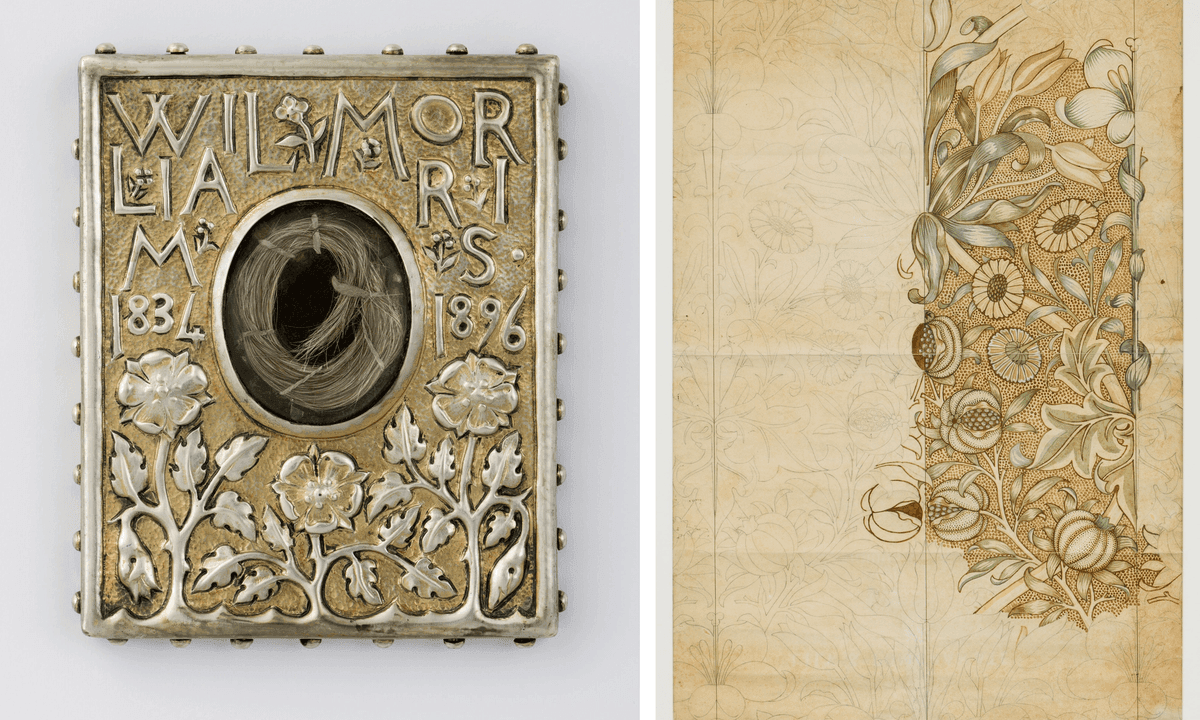
The new reception desk at the William Morris Gallery is made of copper. It points to one source of the family wealth of Morris, the artist, writer and socialist: his father’s investment in the Devon Great Consols Mine in Tavistock. Gallery director Hadrian Garrard says he asked an engraver to add words commemorating the mine’s workers. Children were among those who worked there, in difficult conditions.
The gallery, housed in the Walthamstow home where Morris lived as a teenager, reopened on 3 October 2026. The redisplay covers six exhibition spaces and is the first project of this scale there since 2012.
The displays place Morris’s socialist ideas alongside products made by Morris & Co., the decorative arts and furnishings business he founded. Morris believed beauty should be available to everyone, yet many of his textiles were made for wealthy customers. In one room, a large textile commissioned for a private home is shown near a bag containing the socialist pamphlets he published and distributed.
People living in Waltham Forest also helped shape the redisplay. At family workshops, participants worked on the texts accompanying the objects, with the aim of making them understandable to visitors of different ages.
The new displays give more space to women artists in Morris’s circle. Among the works on show is the design for Flower Garden, an embroidery by his daughter May, who led the embroidery department at Morris & Co. The displays also explore the influence of South Asian and Islamic art on Morris’s designs.
Morris’s political activity is represented by the banner of the Hammersmith Socialist League, which he helped found. On loan from the Working Class Movement Library in Manchester, it is on public display for the first time.
The redisplay does not separate Morris’s art from the economic and social conditions in which it was made. Together, the copper desk, textiles, pamphlets and political objects make the contradictions in his life part of how visitors encounter the work.